Showing posts sorted by relevance for query count screwloose. Sort by date Show all posts

Monday, September 3, 2012

A Spectacular Milt Gross Back to School Screwball Comic (Count Screwloose 1931)

Here's a terrific Milt Gross screwball comic from 1931, scanned from my collection, and featuring a classic panoramic panel of college craziness.

As my son Reid and my girlfriend's daughter, Olivia, are among the millions gearing up to return to school in a few daze, this Count Screwloose about college lept out and grabbed me by the textbooks. As I'm sure readers are aware, American university fraternities have long been a rich vein of wild and wacky behavior. The big joke in the strip below is that the town planners feel a college would add dignity to their community, only to find the antics of college frat boys are anything but dignified!

The topper comic on this page is Babbling Brooks, which refers to the main character - a well-meaning goofus who always manages to say the wrong thing. Even the topper on this page ends with a mad crowd-scene spectacle -- Gross must have been feeling ambitious when he drew this page. Gross did a Babbling Brooks daily early in his career, from October,  1922 to February 1923, and then returned to the character nine years later in his Sunday topper version, from October, 1930 to May, 1931.

Milt Gross' ode to college craziness from April 5, 1931

The structure of this comic is slightly different than many of the Milt Gross Sunday pages from the late 20s and early 30s we've been studying. Instead of a steady escalation of a situation beyond all reasonable expectations, today's comic offers two tiers of a calm, quiet set-up, followed by an abrupt explosion of zaniness. The structure in this comic is not escalation so much as it is an explosion. The first 5 panels are the slow hissing burn of a fuse, and the final, spectacular panel offers a fireworks display of screwball comedy.

Here's the panel, in a large format, so you can appreciate it in all its screwball glory!


In appropriately reverse fashion, let's now take a closer look at the first panel of the Count Screwloose above. Gross has created a vastly over-complex and downright silly mechanism that allows The Count his escape from Nuttycrest. This is undoubtedly a tribute to the great Rube Goldberg, who is famous for his chain-reaction invention cartoons.


Even the final panel of Gross' Count Screwloose cleverly echoes Goldberg's dailies of the time, which were sometimes panoramic one-panels with a tiny panel inset in the lower right (usually a Benny Sent Me).


I don't know yet the exact nature of the connection between Milt Gross and Rube Goldberg. The only mention of Gross in Peter Marzio's excellent 1973 biography, Rube Goldberg His Life and Work, occurs on page 103, where he describes the fantastic 500-guest-large New Year's Eve parties Rube and his wife Irma hosted in 1925-30. Gross was among the many cartoonists there, including Winsor McCay, George McManus, Peter Arno, Billy DeBeck, and many others who all drew cartoons on huge sheets of paper hung on the walls of Rube's home near Central Park. (Oh, to have those sheets!)

Whatever their personal connection might have been, it's clear from studying the work of both cartoonists that Milt Gross was Rube Goldberg's cartoon heir. He carried on Goldberg's approach to comics and humor in cartoon form, right down to building entire series around human foibles such as the difference between what we say and do. The other major screwball cartoonists to notably further this tradition -- including the grand panoramic Hogarthian-style spectacle as seen in the above Count Screwloose -- are Mad's Harvey Kurtzman and Will Elder (who mostly worked together as a team), in the generation after Gross. In this sense, you could say that Milt Gross -- most active in the 1920s and 30s -- is the artistic/screwball link between the work of Rube Goldberg (active 1904-1962) and Harvey Kurtzman and Will Elder (active 1940s-early 1990s).

However, Harvey Kurtzman grew up with the comics of Rube Goldberg, too. His fiorst comics were chalk drawing son New York city streets titled Ikey and Mike (after Goldberg's Mike and Ike They Look Alike).

That's all for now. I have to go steal the Big Boy statue and place him on top of the Space Needle to get my frat pin...

Creator of blogs nice 'n' roomy,
I'm the guy - Paul Tumey

Monday, July 30, 2012

Milt Gross Original Art (1931)

Milt Gross Monday

Presenting a large scan of the stunning original art to a loony 1931 Count Screwloose by Milt Gross!

Yesterday, I posted some swell scans of original art by Walter Hoban. I've decided to make every post this week a look at scans of originals I've collected -- stay tuned and spread the word!

Today's offering is a "topper" strip that ran above the larger Dave's Delicatessen. In earlier posts ( to see these, just click the Milt Gross Monday link at the top right of this web page), I've shared examples of full page versions of Count Screwloose from 1928 - 30. When Milt started his new feature, Dave's Delicatessen, he made Count Screwloose into a topper. Gross also abandoned the frame of the longer version of the strip, in which the Count escapes Nuttycrest asylum, sees "normal" folks acting crazy, and runs back to the relative safety and sanity of the laughing academy. As we see in this topper, Gross changed the Count  into a trouble-causing protagonist instead of a passive observer. The Count is joined in this mischief by his dog pal in the Napoleon hat, Iggy.

Count Screwloose by Milt Gross - circa Nov. 11, 1931 (date unconfirmed)
Meaning well, the Count (who seems to be living with the "Colonel") puts a hair-growing tonic on his pillow. Of course, the pillow becomes glued to the Colonel's head and the comic escalates from this situation into an even more absurd scenario where the Count tortures and humliates the Colonel. The Colonel feebly protests "This is outrageous," but nonetheless winds up smashing through the wall of his house with a pillow glued to his head, much to the delight of preying paparazzi photographers. In the last -- dialogue-free -- panel, the Count and Iggy are taking passport photos, suggesting they are going to leave the country to escape the Colonel's rage.


The last panel reminds me of the way Carl Barks would sometimes end his Donald Duck Walt Disney Comics and Stories 10-page distaster stories. Donald would turn an entire town into an vast omelet, or a valley filled with syrup, or some such disaster --  and in the last panel we'd see his silhouetted figure slinking off into the night, totally defeated. That is, until the next issue, when it would happen all over again.


Gross's visual layout is as well-constructed as his story. Notice how he uses the pattern of the Colonel's pajamas to make his panels more visually busy and dense as the action escalates. In the climactic next-to-last panel, the pj pattern becomes a blur scribbles as all heck breaks loose.


You can see a few non-repro blue marks in this scan, but not many. Gross appears to have very loosely penciled the strip and then boldly inked with the confidence of a master. His line is loose and spontaneous within the well-crafted vessel of his solid story structure and visual layout -- this solidity of form and looseness of execution is the essence (and beauty) of his style.

Tune in Every Monday for a New Milt Gross Comic!


That is all,
Screwball Paul

Monday, July 23, 2012

Milt Gross Teaches Us How to Learn - The Screwloose Way (1930)

Milt Gross Monday

A New Milt Gross Comic Every Monday!

We don't usually associate Milt Gross, the master of screwball comics, with moral lessons and parables. As today's example shows Gross' work is actually filled with trenchant observations of humanity's craziness that could be seen as a sort of textbook on how not to live. This wisdom aspect of screwball comics is actually a fairly common element. Starting with Rube Goldberg's Lunatics I Have Met in the early 1900s, screwball comics embraced insanity in a way that actually shows the reader the logical and expected result to expect from certain choices and attitudes. I sometimes think that screwball comics at their finest are sublime depictions of people tossing and turning as they sleepwalk through life. They are delightful because they are -- in essence -- saying something about the dream state most of us are often in, whether we realize it or not.

Curiously, Milt decorates his canoe in this
comic with a swastika - a very old symbol that was
adopted by the Nazi party in 1920
Today's Milt Gross Monday comic is another in his Count Screwloose series. In this episode, Gross explores the idea of book learning versus acquired experience. As usual, he presents us with a character that takes things to the absurd extreme. The gag is yet another variation on Gross' comedy of escalation, as the self-made man, a skeptic of academia, journeys with great expense and bother to the far corners of the world to learn the exact  knowledge that was first offered to him in a classroom.

Have you ever noticed that sometimes it's not possible to teach someone something simply by telling them? We often must go through our own elaborate Milt Gross style comedies to be able to see what was in front of us the whole time.

Count Screwloose by Milt Gross - Nov 2, 1930
The strip is framed with the usual Count Screwloose structure - the Count escapes from Nuttycrest, leaving his pal Iggy (a dog with a Napoleon complex) in tears at the separation. The Count then becomes our surrogate in the "sane" world as he quietly observes. At the end, overwhelmed by the nuttiness he has silently witnessed, the tiny Count (who is stranded in a distant foreign land) rides on the back of a fish back towards Nuttycrest, dreaming of reuniting with his pal, Iggy.

The art on this page reminds me very much of Sergio Aragones.

Note: I'm not sure if anyone noticed, but we skipped the last two days due to technical difficulties. We have now resumed our normally scheduled broadcast.

That is all,
Screwball Paul

Sunday, August 25, 2013

What Is Art? - A Milt Gross Count Screwloose From 1931 Frames The Question

When you ask yourself questions like "what is art," you are probably setting out on the path that leads to the fruitcake factory. Enuff books and articles have been published on this subject to fill several buildings -- and it would appear that we humans are no closer to an answer we can all agree on than we are to finding a use for screen doors on submarines.

Are comics art? I think so -- some comics, at least. The funny thing is that many comics creators (and I'm talking sequential narratives, here) appear to have been aware that their fellow humans regarded their hard work as innately inferior to the stuff that wound up on the walls in galleries. For many -- even today -- reading comics isn't actually reading -- and comics are associated with illiteracy and simple-mindedness. When someone wants to say something is shallow, they say it's "a comic book treatment." These commentators are only betraying their own ignorance -- for comics are an art form that combines words and image into a highly effective language that may be easy to grasp, but is anything but simple to create.

Many comics creators over the decades have used society's disapproval as grist for their mill. Here's a Rube Goldberg cartoon, circa 1915, in which he suggests the best way to view the new abstract and surreal art appearing in galleries and museums.

Rube Goldberg on modern art - circa 1915
(Photograph of original art)

Milt Gross -- who in many ways is the direct artistic and screwball descendant of Goldberg -- also made sport of the idea of art many times. In a 1931 Count Screwloose Sunday page, Milt Gross dissects for us the mechanics behind the social value of art. In this case, a bum who attempts to get a drink in a bar by reciting a poem receives the comic blow of a pool table on the head. When the same bearded bohemian beggar appears at a society ball clad in his hospital sheet, the wealthy party-goers celebrate his "art." The entire absurd -- but all too true -- situation is witnessed by Count Screwloose:

Count Screwloose by Milt Gross - February 22, 1931
The poem the beggar-poet recites is a very popular poem written in the 1830s entitled Abou Ben Adhem. The author, (James Henry) Leigh Hunt (1784-1859) was an English poet, essayist, and critic -- and a contemporary of Shelly's. His poem -- a depiction of a Muslim written by a Christian that expresses, in the opinions of some, basic Jewish values was a popular hit. Here's the entire text:

Abou Ben Adhem (may his tribe increase!)
Awoke one night from a deep dream of peace,
And saw, within the moonlight in his room,
Making it rich, and like a lily in bloom,
An angel writing in a book of gold:—
Exceeding peace had made Ben Adhem bold,
And to the presence in the room he said,
"What writest thou?"—The vision raised its head,
And with a look made of all sweet accord,
Answered, "The names of those who love the Lord."
"And is mine one?" said Abou. "Nay, not so,"
Replied the angel. Abou spoke more low,
But cheerly still; and said, "I pray thee, then,
Write me as one that loves his fellow men."


The angel wrote, and vanished. The next night
It came again with a great wakening light,
And showed the names whom love of God had blest,
And lo! Ben Adhem's name led all the rest.

Gross' inclusion of Hunt's poem, a chestnut by the 1930s, carries an ironic comment on the actions of his characters in the strip -- neither the pool hall ruffians not the society folks actually show any love at all for the beggar himself. Of course, as Sigmund Freud observed, nothing is less funny than analyses of jokes -- so I'll stop here and encourage my readers to simply dig those great, loose drawings in the strip above.

As to the issue of cartoons, art, and such -- I offer this from the great cartoonist Art Young (1866-1943):

"Some day painting will be glorified cartooning... The painter-cartoonist of the future will be an apostle of big ideas... That he will be an artist of pigment and form is, of course, important; but to be a thinking man of vision, helpfulness and courage, will be more important." (from On My Way by Art Young, 1928)


Artfully Yours,
Screwball Paul

Monday, July 9, 2012

Milt Gross Fur and Wide - Count Screwloose 1928

Milt Gross Monday

A new Milt Gross comic every Monday!


I've been sharing some prime examples of Milt Gross' Nize Baby, the hyper-screwball chronicles of the ill-fated Feitelbaum family. Today, I'm layin' a new and equally terrific Milt Gross comic, Count Screwloose of Tooloose on your pleased peepers.

This feature gave the world the once popular catchphrase, "Iggy keep an eye on me!" The basic frame of the strip is the same in every episode: The Count escapes from the Laughing Academy, leaving his (imaginary?) dog pal, Iggy, behind. Out among the normal and sane folks, the Count sees episodes of people doing such nutty stuff that he runs back to the relatively saner asylum and Iggy, begging "Iggy, keep an eye on me!"

The theme of insanity in everyday life is one that was introduced into comics and developed into a rich wellspring by Rube Goldberg. Gross and Goldberg were pals, and there's no doubt that Gross was heavily influenced by Goldberg's methods of reaching for the funniest image over the best-drawn, and of deriving humor by revealing how no one is spared from moments of sheer screwball behavior.

Today's offering is a very early episode of the comic, scanned from my own paper collection, complete with the original Bananna Oil topper. Gross' Banana Oil is very similar in concept to Rube Goldberg's cartoon series, Baloney, which became a catchphrase: "No matter how thin you slice it, it's still baloney!" Gene Ahern, that other towering screwball cartoonist, would occasionally have his characters utter "pickle smoke!" in the same vein.

This page has The New York World cutline at the top of the page. The World was one of the first papers to hire Gross, publishing his Gross Exaggerations column, out of which grew the Nize Baby comic. In 1931, Gross was hired into the King Features group of cartoonists by William Randolph Hearst, and his comics saw a much higher circulation, winning him national popularity. The pre-1931 Gross Sundays are especially fresh and edgy, taking chances and boldly striding into place few other newspaper cartoonists dared to go.

I've mentioned before that Milt Gross' Sundays are about the comedy of escalation. This comic is no exception, as the neighboring wives compete with each other to see who can acquire the largest fur adornment until they become, um, grossly puffed up in the sublime wordless 11th panel -- a perfect visual metaphor of the inflated ego. There's another joke in play as well, as the men work ever harder to support this insane prideful competition.


Count Screwloose of Tooloose by Milt Gross - May 12, 1928
(from the collection of Paul Tumey)

In the end, the Count bikes furiously back to Nuttycrest and his canine pal Iggy. I've always thought it was funny that Iggy wears a Napoleon hat, a cartoon symbol of insanity -- he's there as a fellow inmate!

Don't Miss:

tomorrow's Rube Goldberg Tuesday!


That is all,
Screwball Paul


Monday, October 22, 2012

Screwball Sunday Supplement Vol. 3 No. 33 - The Squirrel Cage, Swinnerton's Hilarious SAMs, & Count Screwloose


GREETINGS FROM THE LAUGHING ACADEMY!

Welcome to the third issue of our Screwball Sunday Supplement. This issue is packed with comics that ALL have produced guffaws and laffs amongst me self and me pals. 

We kick off with a superb Milt Gross Count Tooloose that could well be the prototype for Tex Avery's classic Droopy cartoon, "Dumb-Hounded." We also get a Milt Gross Banana Oil topper. This was a very popular strip in itself back in the day, with folks saying "banana oil!" instead of "bullshit!"

In the interior spread, we get the extra-special treat of 4 Squirrel Cages, all from the 1946 detour from Foozland into Goonia. This is Gene Ahern at his most inspired, most trippy, most sublimely screwball.

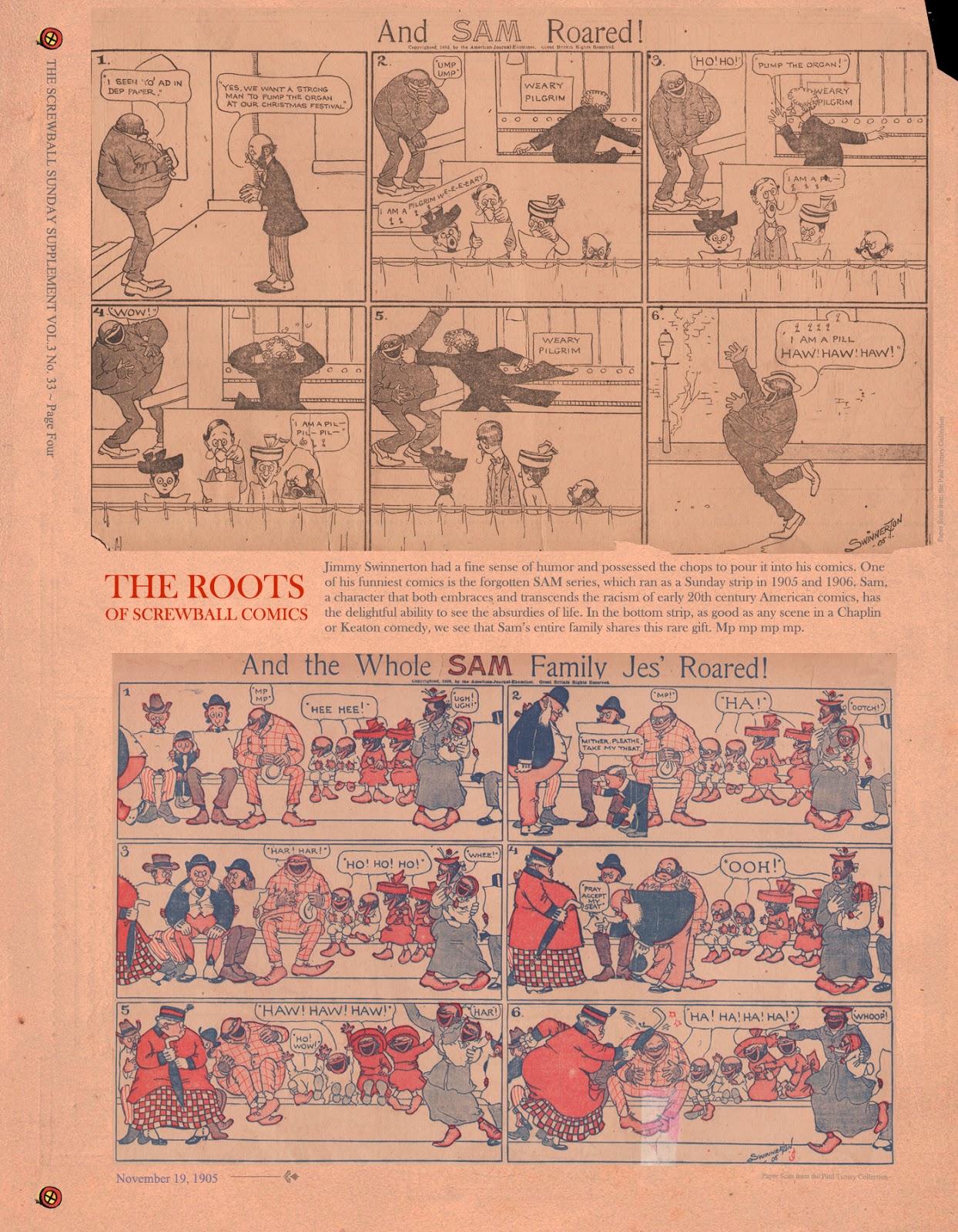
On the the back page, we find two truly funny rescued 1905 Jimmy Swinnerton gems from the Platinum Age of American newspaper comics that I hope you will take the time to read, as I think they are something special, racial stereotypes aside. 

Swinnerton's SAM strips echo Gross' Banana Oil and Count Screwloose comics in that they both provide a surrogate observer into the strip in the form of the Count, and Sam. Where black American Sam laughs at pomposity, Jewish American Screwloose is aghast at hypocrisy. Sam may have the more light-hearted  response, but in all fairness, he "mp-mp-mps" in an earlier and more innocent era, before the horrors of the 20th century transpired.

Just as Sam and The Count are doorways into their comic strip worlds, Ahern's Paul Bunyan-as-bewitched-gnome is a surrogate figure for us in The Squirrel Cage, through which we can comfortably explore the weird worlds of Foozland and environs. Ahern fractally inserts a multitude of additional doorways into his strip, going ever deeper into the labyrinth, until it's impossible to tell the dream from the dreamer -- do we dream of the snarky citizens of Goonia, or do they dream of us?

Ump, Ump ~
Paul Tumey


Sunday, April 21, 2013

The First Dave's Delicatessen by Milt Gross - 1931


Here's the very first Dave's Delicatessen Sunday by that inimitable achiever of screwballosity, Milt Gross. 

Dave's Delicatessen ran as a Sunday from June 7, 1931 to January 13, 1935. It was accompanied by the toppers Count Screwloose (an abbreviated version of an earlier full page incarnation) and That's My Pop. The comic also ran as a daily strip from July 13, 1931 to August 5, 1933. Here's three examples of the daily:


The basic idea of the strip was that Dave ran a Jewish deli and each episode featured a different eccentric character or characters coming across Dave's path. It was a toned-down, inverted variation on Milt Gross' theme of insanity in everyday life. Where Papa Feitelbaum in Nize Baby over-reacted in crazy ways, Dave is always grounded in a world of crazy characters. In his previous Sunday pages, Nize Baby (1926-1929) and Count Screwloose of Tooloose (1929-1931), Gross created epics in miniature around the comedy of escalation. You can read some of these operas of comic destruction and frustration  in these postings:

Why Don't He Twitt: An Insane 1928 Milt Gross Nize Baby

The Escalated Hypocrisy of Milt Gross' Count Screwloose

Dave's Delicatessen moved to a different, more subdued rhythm -- but saying a Milt Gross strip is subdued  is a little like saying a half dozen bottle rockets is not as explosive as a roman candle. In his new strip, Gross -- ever the growing artist -- challenged himself with moving from episodic to narrative humor. While each episode of Dave's Delicatessen remains a single unit with very little continuity, Gross often presented entire little compressed stories with a beginning, middle, and end -- all worked into a single Sunday page.

Such is the case with the very first 18-panel episode of Dave's Delicatessen, in which Dave is completely conned by two silly swindlers. It's a brilliant debut, jam-packed with Gross' visual and verbal play, oddballs, and goofy scenes -- such as in panel 8, in which a woman shoplifts a sausage with a expanding grabber thingie protruding from the pocket of her socialite dress.


The first Dave's Delicatessen by Milt Gross
June 7, 1931
(courtesy of Carl Linich)

Look at how, in the last panel, Gross makes the mug shot book unrealistically gigantic -- allowing us, the reader, to see what it is. This sort of freedom to expertly stray from one-on-one representation reveals the true mastery of Gross. While Dave's Delicatessen doesn't provide as many visual pyrotechnics as his earlier strips, it does offer some of the most stuffed comics ever -- and belongs among the greatest of Milt Gross' achievements.

Many thanks to Carl Linich, who provided this beautiful paper scan from his own collection.

All the Best,
Paul Tumey

Monday, September 24, 2012

The Hilarious Hypocrisy of Banana Oil by Milt Gross (1925)

Today we peel our eyeballs for a potent trio of extremely rare, early Milt Gross Banana Oil dailies from 1925.

The concept of Banana Oil was to show in each episode the difference between what people say and what they actually do. The phrase, "banana oil," is slang for "bulls--t." It was, in many ways, Gross' first success, capturing the many different shades of human dishonesty in a friendly, comically brilliant way. Each episode gave us different characters and different situations.

In this respect, Gross was extending the "concept strip" form that Rube Goldberg, his artistic and spiritual mentor, primarily developed in the United States with such popular series as Foolish Questions and I'm The Guy. In fact, Rube Goldberg had several series about human hypocrisy, including Telephonies, Phoney Films, and No Matter How Thin You Slide It, It's Still Baloney.

Banana Oil ran for roughly 7 years, first as a daily ( Dec. 31, 1923- Oct.30, 1925) and then as a topper (Sept. 12, 1926-Sept. 28, 1930)* to the Sunday Nize Baby and later Count Screwloose. You can see a 1928 example of the color Banana Oil topper here.

In 1926, Milt Gross said in an interview that:

1926 Milt Gross portrait by fellow
cartoonist Herb Roth
(who mainly ghosted for H.T. Webster)
 "Banana Oil was more myself than anything else I've ever done. It contained all that I feel about life and the bunk that the world is so full of. I poured out my heart in it -- strange though that may sound." - Milt Gross, 1926

The 1926 article from Success magazine by David Balch describes Gross as "a very energetic young man possessed of a withering contempt for four-flushers."

Gross' daily set the pattern for his work to come, with a crazy kaleidoscope of ever-shifting characters and situations, all drawn with an appealing screwball energy. Here's three selected Banana Oil dailies for your henjoyment.

First up is a great example of hypocrisy through self-delusion:

May 23, 1925


Next is an example of someone who is well-aware they are being deceitful, but comically tries to cover-up. It's also a nice chance to see Gross draw pin-up girls.
July 21, 1925


Lastly, here is an example of "the public" calling BS -- in a comic that graphically anticipates the extraordinary, everything-but-the-kitchen-sink type panels of unrestrained screwball chaos, as can be seen in  his April 5, 1931 Count Screwloose Sunday (you can read that comic here)

May 7, 1925
That's all for today. I need to go count the piles of money rolling, get  my morning massage, and have Hives, my butler serve me lunch.**

Inhaling Pickle Smoke,
Paul Tumey
_________________________________________________________________________

*Information from American Newspaper Comics: An Encyclopedic Reference Guide by Allan Holtz (2012, University of Michigan Press)

**That's a lotta banana oil!

Sunday, July 15, 2012

The Elements of Screwball Comics

Screwball comics share some or all of the following eight elements:

- Disruptive and eccentric behavior
- Corny jokes, puns, and wordplay
- Extreme reactions and frantic movements
- Exaggerated physical features of humans and animals
- Crazy inventions
- Nonsense and surrealism
- Self-referential (references to being a cartoon)
- Parodies various forms of popular entertainments

American screwball comics were heavily influenced by the work of Rube Goldberg who
introduced several key elements of the genre into newspaper cartoons

Sometimes straight comics (adventure, romance, western, superhero) use screwball characters to add a little pizzazz, such as  B.O. Plenty in Dick Tracy or Superman's goofy foe, Mr. Mxyzptlk .

In other cases, comic strip and comic book features  tend to more or less constantly play with these elements -- and can be classified as being of the  "screwball" genre. When you read a screwball comic, you feel a little like your brain has been put in a blender. The pace is frantic, the wit is both verbal and visual (or unique combinations of both), and the disruption to one's sense of reality is quite strong. For those of us who like this disruptive humor, it's addicting.


This Milt Gross page from November 30, 1930 displays all six elements of screwball comics

The most notable of these comics include (in alphabetical order):

- And Her Name Was Maud by Frederick Opper
- Babe by Boody Rogers
- Baron Bean by George Herriman
- Basil Wolverton's comics (various titles)
- Boob McNutt by Rube Goldberg
- Bobo Baxter by Rube Goldberg
- Count Screwloose of Tooloose by Milt Gross
- Death Patrol by Jack Cole, Dave Berg, Gill Fox
- Dave's Delicatessen by Milt Gross
- Dinky Dinkerton by Art Huhta
- Doc Syke by Ving Fuller
- Hawkshaw the Detective by Gus Mager
- Hey Look! by Harvey Kurtzman
- High Pressure Pete by George Swanson
- Jerry On The Job by Walter Hoban
- Jingle Jangle Tales and the Pie-Face Prince by George Carlson
- Jingling Johnson by W.R. Bradford
- Lalapalooza by Rube Goldberg
- Little Jimmy by James Swinnerton
- Mager's Monks by Gus Mager (including Sherlocko)
- Midnight by Jack Cole
- Needlenose Noonan by Walter Hoban
- Nize Baby by Milt Gross
- Our Boarding House by Gene Ahern
- Plastic Man by Jack Cole
- Powerhouse Pepper by Basil Wolverton
- Room and Board by Gene Ahern
- Rube Goldberg's various comic strips from 1910-1927
- $alesman $am by George Swanson, C.D. Small
- Sam and His Laugh by James Swinnerton
- Sappo by E.C. Segar
- Smokey Stover by Bill Holman
- Sparky Watts by Boody Rogers
- Spooky by Bill Holman
- Stumble Inn by George Herriman
- That's My Pop! by Milt Gross
- The Dingbat Family by George Herriman
- The Nut Brothers by Gene Ahern
- The Squirrel Cage by Gene Ahern
- Thimble Theater by E.C. Segar

This list is a work in progress. If you have any suggestions to add to it, please let me know!

I mentioned the dense quality of many screwball comics. In many cases, these comics have simultaneous multiple gags. In a single panel instead one event happening, there can be two or more events occurring. Often screwball comics have extra gags and jokes in the background. Also, the dialogue can be working on multiple levels, advancing the plot while also delivering jokes and puns. A great screwball comic is a virtuoso juggling act. "Background gags" could be seen as a seventh element, but it doesn't occur in enough screwball comics to be considered as a key element.

A genuine screwball comic is not something that is easily imitated successfully. Many have been influenced by Rube Goldberg, but no one ever tried to do exactly what he did. Few successors, if any, have managed to capture the magic of Jack Cole's Plastic Man. Segar's Popeye is still good stuff in the hands of Zaboly and Sagendorf, but no match for Segar's work. No one ever tried to carry on Count Screwloose, Powerhouse Pepper, The Squirrel Cage, or Sparky Watts once the original creators stopped generating stories. For this reason, it's better to study screwball comics through the masters of the genre.

These elements will be our guideline in exploring screwball comics in the months ahead. And now, for your entertainment, here is a Gene Ahern Room and Board from 1943 that plays with some of the elements of screwball comics. In this case, we see:

- Outlandish and eccentric behavior
- Crazy invention (the hair tonic)
- Exaggerated physical features
- Nonsense and surrealism

A screwball Room and Board by Gene Ahern - Oct 10, 1943 (from the collection of Paul Tumey)


That is all,
Screwball Paul


Monday, August 13, 2012

The Escalated Hypocrisy of Milt Gross' Count Screwloose

Milt Gross had several dynamics in his humor. One was the comedy of escalation, in which he kept increasing the conditions of a situation to ridiculous extremes. Another dynamic Gross employed is the humor of hypocrisy, in which he draws laughter from the difference between what people say and what they actually do. Gross built an entire strip, Banana Oil (daily 1923-25, Sunday 1926-30) on the latter dynamic In today's comic, a large, cleaned up 300 dpi paper scan from my own archives, Milt puts both of these dynamics into play.

Escalation occurs when the protagonist of this episode, as observed by the Count, has to deal with one crazy interruption after another. Neckties and insurance are silly enough, but a picture on a pony is pretty screwy!

The hypocrisy sets in when we see that our guy was very patient and allowing of the interruptions at the office, but when his son asks him a simple question at home, he explodes with comic rage, destroying his home and spanking his child. Gross -- a dedicated and loving father -- shows us how NOT to be a Dad. At the end, the Count and Iggy play pool at Nuttycrest with veggies and a broom. Along the way, we meet a host of odd and entertaining characters. I ask you, does it get any better?

The comedy of escalation and the humor of hypocrisy are the foundations for a superb Milt Gross screwball comic
January 18, 1931 (from the collection of Paul Tumey)


The first panel is Milt Gross' version of the classic Rube Goldberg chain-reaction invention cartoon. Gross did a few of these in 1931.


I don't know if he and Rube were friends, but I do know that Gross looked up to Rube and was heavily influenced by him. The doctor in this comic is straight outta Rube Goldberg casting...


And, just for fun, here's a couple of close ups of cartoons from today's Milt Gross Monday comic that show Milt's endless inspiration for drawing funny people. What makes these work is that these aren't just drawings... these characters have their own agendas and motivations -- they think they are real!


Well gang, sadly I must inform you that this will probably be the only post I can manage this week and next. I am still eyebrows-deep in a screwball comics related project that is claiming most of my time. In a week or so, I am flying from Seattle to New York City to work lend a hand on an exciting new  Rube Goldberg book by Jennifer George -- Rube Goldberg's grand-daughter and Director of Rube Goldberg, Inc. My fellow screwball scholar, Carl Linich will also be helping out on this book, and I'm looking forward to meeting him in person! There is much prep work to be done this week, including a mountain of scanning and so I have to give my usual "blog time" to this new project for a couple of weeks. Around all this, I am still running Presentation Tree and being a single father during summer vacation - phew! I hope you'll kindly forgive the infrequent August postings, knowing that my energies are contributing in a very small way to help create a cool new book on a screwball master!

Please browse around the older articles you may have missed -- there is already a lot of good reading material on this blog.

A lot more Milt Gross comics you can only find on this blog (new scans from my archive of paper originals) are posted here.

And please spread the word about this blog -- Screwball Comics, Now More Than Ever!

Flip-takingly Yours,
Paul Tumey

Monday, July 16, 2012

Milt Gross Meets Rudy Megaphone (1930)

Milt Gross Monday

A new Milt Gross comic every Monday!


Ah, celebrities. We love 'em.

It's said that Albert Einstein read and adored Milt Gross. Paul Picasso, James Joyce, and Gertude Stein were avid fans. Robert Frost wrote an (unpublished) ode to Count Screwloose. It's well known that meetings between FDR and Churchill often broke down into laugh-fests over Gross's books. Years later, JFK and Kruschev discovered peace-promoting common ground over a mutual regard for the comics of Milt Gross (Nixon never liked them - he said didn't get them). More than one scientist has credited Gross' fractal-driven images as the primary inspiration for the discovery of the DNA double-helix model.  Even the great film comedian Charlie Chaplin loved the humor of Milt Gross so much that he hired him to help write one of his greatest films, "The Circus."


Eau Kaye, so I might be elaborating just a tad. I actually made up all of the above, just for fun. Wouldn't it be wonderful if any it were true? Waitaminnit! One part of all that nonsense IS true, wonderfully true: Milt Gross really did co-concoct with Charlie Chaplin (also his pal) -- that much is true. Here's a sweet little newspaper item from 1926:

Hartford Courant, May 5, 1926
The above article was found on the wonderful website, Silent Comedians, which will interest many readers of this blog.

Here's today's Milt Gross offering, a full Sunday page meditation on  celebrities, in this case the immortal Rudy Megaphone:


That's all for me today! I'm leaving this booby-hatch for a saner world and smarter people!

Sincerely Not,
Count Tumeyloose

Friday, November 16, 2012

The Secret History of Screwball: A Squirrel's Progress

While Gene Ahern's world of Our Boarding House and Room and Board explores the archetypes of early 20th century small town America, his multi-year Foozland continuity in The Squirrel Cage vastly and mind-blowingly expands his canvas, offering an allegorical journey through an entire alternate universe.

___________________________________________

Note: Georgian folksinger and comics scholar Carl Linich has posted 10 of the rare Paul Bunyan strips from Gene Ahern's The Squirrel Cage on his blog here.
____________________________________________

Unique among American newspaper comic strips, The Squirrel Cage has a structure that allows broad philosophical and social commentary in the innocent guise of a goofy Sunday comic. Where strips like Pogo and Doonesbury offer sharp topical political commentary, The Squirrel Cage provides a more philosophical-poetical -- almost a Shakespearian perspective on social trends, morality, and government. One hesitates to say how much of the wisdom expressed in The Squirrel Cage is intended or deliberate.

To me, it feels like Ahern in the 1940s knew he was on the mainline connection to his subconscious, and somehow was able to make it flow for years, while at the same time meeting (just barely, and with decreasing sales) the demands of the American newspaper comic strip market. A remarkable feat. Contrast the dreamlike play of a Squirrel Cage comic with the pointed, pun-drenched satire of a Pogo Sunday, and you can see a profound difference between an artist offering superb craftsmanship and an artist revealing his subconscious. There's a very real link between Ahern, psychedelic Underground comics of the 1960s, and the free-flowing stream-of-consciousness social and spiritual commentaries of Steve Willis. While I love Walt Kelly's work, for my money, the surreal, screwball association of Ahern's comics are more valuable to me, because they offer a way to bypass the limitations of rational thinking and reveal something deeper, weirder.

Reading The Squirrel Cage is exciting because it's delightfully odd, and that oddness is rooted in a dreamlike exploration of reality itself. Humor at its best is always based on sharp insights about the world. Ahern's humor grew more sophisticated in this way with each passing year. Finding poetic-philosophical meditations in a forgotten old screwball newspaper comic strip is tantamount to discovering the profound philosophical-religious explorations of Philip K. Dick that were originally packaged as 1950s and 1960s pulp magazine and cheap paperback science fiction.

In the Foozland strips of The Squirrel Cage, Gene Ahern -- a cultured man who (according to his press) used his cartoonist's salary to collect paintings by European masters -- presents a kaleidoscopic view of a fantastic world. His landscapes shift from panel to panel. George Herriman's Krazy Kat is famous for its ever-morphing landscapes; Ahern's Squirrel Cage is virtually unknown but employs the same device with equal artistic success.  The multi-year aimless drift through Foozland offers hundreds of bizarre characters, odd plants and animals, and distorted physical laws that reveal, in a disguised and surreal way, underlying truths about our social systems and the subjective nature of reality.

Where Our Boarding House (1922-1936) and later Room and Board (1936-1953) are centered on the delightfully self-deluded world of Major Hoople/Judge Puffle, The Foozland strips of The Squirrel Cage (1936-1953) are subversively directed outward, with a constant focus on the environment instead of the interior world of a central character.

A typical Gene Ahern Our Boarding House episode, encased in the limited -- but comically rich -- world of
Major Hoople's delusions...


The Paul Bunyan Gnome

The closest thing we have to a central character in the Foozland strips of The Squirrel Cage is the red-yellow-black clad gnome (the same color scheme worn by Jack Cole's form-bending Plastic Man).


Attentive readers of The Squirrel Cage know the little gnome -- a doppleganger for the the Little Hitch-hiker (who also appears in the Foozland strips) -- is actually Paul Bunyan, the mythic logger giant from American tall tales!


The Squirrel Cage by Gene Ahern - March 10, 1943
One of the earliest of the 'Paul Bunyan" strips - note the Little Hitch-hiker appears in the last panel

This alone is a wonderful surreal gag, but Ahern dropped it after a couple of years. After Paul Bunyan tangles with an ill-tempered witch, he is reduced to a pint-sized lawn-ornament style gnome and banished to the mysterious country of Foozland, where the laws of humans and nature are radically different from our collective reality. After this transformation, the strip never again refers to the gnome as Paul Bunyan. He is essentially a cipher, with no name, no purpose, and no character -- the very opposite of the richly human Major Hoople and Judge Puffle.

The Bunyan-gnome initially wanders Foozland with a vague purpose of returning to his own world and form. This purpose becomes hazy, and finally forgotten as he is subsumed into the dreamworld of Foozland. Reading the Foozland strips in sequence reveals a "hidden" story of a character lost in a dream and unable to wake up.

Bunyan-gnome occasionally breaks through the borders of Foozland, but instead of returning to our universe, he finds himself in places like Goonia, which is merely another country in the un-named alternate universe. The strip is filled with a never-ending labyrinth of magic doors, caves, tunnels, and stairways that force the gnome (and the reader) to abandon all sense of direction and bearing. Ahern has created on paper a metaphor for what living itself feels like (at least living unconsciously), with its unexpected twists and turns that lead us through a daily parade of bewildering dead-ends in our search for security and reassuring (and non-existent) consistency.

The main visual symbol of travel in the Foozland strips is the ever-present Road, on which characters mostly travel left-to-right, in a mirror-image of the way English-speaking peoples read symbols and (most) sequential graphic narratives.

Minor masterpieces like The Squirrel Cage, because they have been ignored and forgotten, appear to spring up from nowhere, but this is far from the the truth. This lost comic strip actually continues a centuries-old tradition of allegorical storytelling, and traces to some surprising cultural cousins on the nut-laden screwball family tree.


The Origins of Foozland: Bunyan to Bunion

In considering the possible antecedents of Gene Ahern's Foozland, it helps to recognize the strip has an allegorical tone. In some cases, the strips may function as an allegory -- which is a story structure in which characters symbolize ideas and concepts -- and some cases, the strips only assume an allegorical tone, because at their heart, they are more surreal, eschewing any direct, one-to-one correlations between character and concept.This was, after all, first and foremost, entertainment for the masses.

The allegorical tone of Gene Ahern's Foozland strips can be traced back to A Pilgrim's Progress, a little-known series by Winsor McCay, one of the greatest artists of the medium.

Perhaps the first great allegorical comic - A Pilgrim's Progress by Winsor McCay

According to Allan Holtz's American Newspaper Comics: An Encyclopedic Reference Guide (2012), A Pilgrim's Progress ran on weekdays from June 26, 1905 to May 4, 1909.

In McCay's A Pilgrim's Progress, we see a tall, gaunt man clad in black carrying a suitcase called "Dull Care." As with the gnome-Paul-Bunyan in The Squirrel Cage, he seems to almost always journey from left to right, on an eternal Road. McCay's Pilgrim (who is sometimes referred to as "Mr. Bunion", a play on John Bunyan's name) ) encounters one tortured soul after another, and is unable to put his suitcase down to help. In the example shown above, we see a man driven crazy by his own outrage at  the world's injustices -- unable to see that his "truth-telling" is really a form of blindness. He's an allegorical figure representing mindless blaming. Other people our Pilgrim encounters represent greed, gluttony, lust, hypocrisy, and so on. The Pilgrim himself respresents Everyman, who is burdened with the weight of the world and "worries for the entire universe."

A Pilgrim's Progress by Winsor McCay
From Winsor McCay The Early Works Volume 2, page 174 (Checker)

Signing his series as "Silas," McCay reminds me of Hank Williams posing as "Luke the Drifter" -- both men adopting a new persona to deliver sermons in the form of entertainment.

In his lilting musical sermon, "I've Been Down That Road Before," Hank Williams recites:

"To bully folks and play mean tricks was once my pride and joy
Till one day I was toted home and mama didn't know her little boy
'My head was swelled up so doggone big I couldn't get it through my front door
Now I ain't just talkin' to hear myself, cause I been down that road before"  

The image of a man's head swollen so large seems oddly resonant with Winsor McCay's dream imagery, not to mention some scenes from the Foozland stories which explicitly feature swelled heads and other physical transformations. Compare William's "doggone big" head with McCay's giant hammer in the last panel of the Pilgrim's Progress example above.

Note also William's use of the allegory of the Road as spiritual path. This is the same road McCay's Pilgrim and Ahern's Paul Bunyan-gnome travel.

Williams adopted the alter-ego of Luke as a way to deliver sermons to 1950s America without lessening the marketability of his name, popularly associated with "honky tonk" country and western songs like "Your Cheatin' Heart."

You can here the entire Luke the Drifter sermon of "I've Been Down That Road Before," here:


The "Dull Care" suitcase Winsor McCay's pilgrim totes -- a burden he cannot share -- also resonates with another 20th century musical icon, the 1968 song The Weight. Composed and performed by The Band, and appearing as the centerpiece of their first album, Music From Big Pink,  the song was inspired by Luis Bunuel's symbolic films of spiritual quests through absurd situations. The Weight seeks to create an allegory of a burdened man wandering, very much like McCay's Pilgrim and William's Luke the Drifter. The wanderer carries a "bag" (which in 1968 America had a double meaning, since "bag" was a slang for "purpose" -- as in "what's your bag, man?") and encounters a dizzying variety of odd characters.

"I picked up my bag, and went looking for a place to hide
When I saw old Carmen and the Devil, walkin' side by side
I said "Hey Carmen, let's go downtown."
She said, "I gotta go, but my friend can stick around."
- The Weight, The Band

One of the characters in The Weight is named Luke, perhaps a tip of the cowboy hat to Hank.

The actual full title of McCay's strip is A Pilgrim's Progress by Mr. Bunion. The readers of 1905-1909 would have been more familiar with the comical, self-depreciating reference to John Bunyan, author of the 17th century bestseller, A Pilgrim's Progess.

John Bunyan - not a screwball artist, but pretty screwy

Bunyan, who began writing Pilgrim's Progress while in prison for preaching without a license, would have fit right in with the strange characters of The Weight, McCay's worlds, and Foozland. He spent much of his adult life seeking to redeem his wild youth in which he committed such immoral acts as dancing and bell-ringing. He was -- to give him credit -- legendary among his young peers for his ability to swear like a sailor. Bunyan apparently turned his wordsmithing talent to a higher purpose, and wrote one of the most famous books in the English language, A Pilgrim's Progress, a book that perhaps the younger Bunyan might have said was damned good and fucking weird.

Here's a small part of the Wiki summary of the book:

"On his way to the Wicket Gate, Christian is diverted by Mr. Worldly Wiseman into seeking deliverance from his burden through the Law, supposedly with the help of a Mr. Legality and his son Civility in the village of Morality, rather than through Christ, allegorically by way of the Wicket Gate." 
We can go back further than John Bunyan and the 17th century, to Dante's early 14th century Divine Comedy, an exploration of Heaven, Hell and Purgatory, filled with surrealism and some of the best allegory money can buy. Modern day cartoonist-allegorist Gary Panter has recreated two of the books of The Divine Comedy, with Jimbo in Purgatory (2004) and Jimbo's Inferno (2006).

Milt Gross' Count Screwloose witnesses widespread insanity in a spectacular panel from April 5, 1931

The witnessing of humanity's suffering and unconscious insanity that McCay's Pilgrim provides is not that different from the adventures of Milt Gross' Count Screwloose, who regularly escapes from the looney bin (sometimes with a Rube Goldberg machine) only to see so much craziness in the outside world that he is happy, at strip's end, to return to the relatively sane world of the Nuttycrest asylum for the mentally disturbed.

When you look at it, there seems to be some sort ongoing discussion, first in strange books and then in strange comics, about journeys through screwball worlds.

Can it be mere co-incidence that Ahern shifted his wacky screwball strip about two inventors and a little hitch-hiker into an allegory by way of a character called Bunyan? Perhaps the DNA of the secret history of screwball comics looks something like this:


When we consider the dreamlike imagery found in The Squirrel Cage (and The Nut Brothers, an earlier Ahern surreal romp) it makes sense, then to look at the first page of the first publication of  John Bunyan's The Pilgrim's Progress and see the word "dream" write large:

Title page for John Bunyan's The Pilgrim's Progress


The Fun of Going Nowhere

When he created the Foozland continuity in The Squirrel Cage, Ahern built a serial dream that lasted years and went nowhere. The very title of the strip is a natural extension of the many squirrel and nut labels used in screwball comics, from Rube Goldberg's Boob McNutt to Ahern's own Squirrel Food and Nut Brothers. But there's another layer to the strip's title, since a squirrel cage is a confining environment in which a squirrel can run forever without ever getting anyplace -- just like the Buyan-gnome in Foozland.

With his invention of Foozland in The Squirrel Cage, Gene Ahern built one of the most elegant and incisive tools for social commentary in all of American comics. The strip below, from 1945, the first year of the Foozland continuity (at some point, something must be said about the meaning of Foozland's birth coinciding with the end of World War 2 and the arrival of The Bomb), provides an allegory on leadership with some dreamlike lampoons of government and social responsibility.

The Squirrel Cage by Gene Ahern - April 8, 1945
(from the collection of Paul C. Tumey)
Let's take a closer look. In the first panel, we begin with the Little Hitch-hiker and his classic existential nonsensical question: "Nov shmoz ka pop?" Ahern almost always drew an absurd object next to the Hitch-hiker, and here we see a giant block of ice, defying the laws of physics by not melting -- a visual gag Ahern used many times in The Squirrel Cage -- nevermind WHY the Little Hitch-Hiker has a block of ice with him. In the first moments of the strip, we are already confounded. As the Hitch-hiker hitchhikes, the King of Foozland walks The Road, left to right, declaring he is taking a day off. because he is king, the plants and animals must bow to him. His train is kept from touching the ground not by a servant, but by a little wheel.


The impulsive King of Foozland encounters the Bunyan-gnome, who is always on The Road, and makes him King. The crowned gnome, now bowed to, has no idea how to be a King. He stands on a path that has mysteriously developed a set of steps leading down - an allegorical symbol that he may be headed for a moral descent if he doesn't use his newly acquired power well.


Next, the King must sign a law -- the lawmaker acknowledges the power of the crown, whil ealso acknowledging that the gnome is not the real King. The law itself is comically huge, a giant scroll that is
so heavy (the Weight) he struggles to carry it.


The law is against beards, but as the lawmaker explains this, a long full beard appears on his face.


In the early 1990s, I lived in Leominster, Massachusetts, a small town filled with plastic factories and -- ironically -- famous as the birthplace and home town of Johnny Appleseed. One day, while walking home through the city cemetery, I came across a curious gravestone:


It seems that in the late 18th century, Leominster citizen Joseph Palmer was intolerantly attacked by his fellow townsmen for wearing a full beard. The book, Weird New England, tells us his clean-shaven peers thought Palmer's full beard was "antisocial and sinful." This resonantes with John Bunyan's self-persecution for dancing and bell-ringing. He was jailed for causing a disturbance of the peace and kept for a year. Palmer was finally released, refusing to cut his well-groomed beard. His jailers tied him to a chair and threw him from the jail.  The "no-beard" law in Gene Ahern's April 8, 1945 Squirrel Cage reminds me of Palmer. In effect, when the beard magically appears on the man who wants to outlaw beards, something is being said about human versus moral law. Realizing he has a beard (without ever questioning why or how that he could grow a long beard in a second), the lawmaker instant shifts his focus to outlawing people WITHOUT a beard -- thus he has become an allegorical figure for Intolerance. In the background a Herriman-esque tree appears to have a fuzzy hat, or perhaps a beard.


Realizing that he almost signed into law something that "put people in trouble," the gnome begins to question whether it is right for him to wear the crown. There's an old saying that the best leaders are those that do not wish to lead -- it seems the gnome has common sense, and perhaps even moral sense. The tree he touches is multi-colored and oddly shaped -- it seems to resonate with a meaning, but its unclear what that meaning may be.


In a small heroic gesture, the gnome divests himself of the power and responsibility of rulership, and bestows it upon a scarecrow -- a "fake" human.


In the last panel, the former King of Foozeland, now a mere subject, bows to the crowned scarecrow. It's almost as if there's no importance placed on who leads, but only that there is a leader -- even if it's only a scarecrow. Woody Guthrie once famously said, when asked of about his political affiliation, "right wing, left wing, chicken wing -- it's all the same to me."  Of course, this was nonsense, since Guthrie was a well-known radical activist of his time, but in this nonsense -- like the nonsense of The Squirrel Cage  -- is valuable -- and shocking -- wisdom.


Your Screwball Scribe,
Paul Tumey

All text copright 2012 Paul C. Tumey