Showing posts with label Rube Goldberg. Show all posts

Tuesday, April 1, 2014

Rube Goldberg's April Fool's Day Comics

Of all the great American newspaper comic strip cartoonists, Rube Goldberg perhaps most embraced the spirit of the repressed mischievous prankster. It's no surprise that, while Goldberg regularly commemorated national holidays such as Christmas and July 4 (also his birthday) in his daily newspaper comic strip, he seemed to invest extra effort into his strips that ran on April 1, or April Fool's Day -- the day of the prankster.

Goldberg's April 1 strips offered a variety of tongue-in-cheek set ups, including fake cartoons, spurious announcements, and puzzles that, when assembled, formed the words "April Fool." One gets the sense that, while other artists drew strips such as The Katzenjammer Kids about merry jokesters, Rube Goldberg himself was one of those kids!

Being a sensitive person who seemed to like people, Goldberg rarely -- if ever -- stooped to playing practical jokes on others. He might lacerate you with slashes of his comic wit, but he probably wouldn't put salt in the sugar bowl. Instead, he sublimated his impulse to prank into his work, and his April Fool's Day comics often ripped away the facade and laid bare the desire to trick. This can be seen in his April 1st strip of 1914 that makes fun of the common tricks of the day:

April 1, 1914

Early in his career, Goldberg had been the victim of a cruel practical joke. In 1905, as a newcomer to the staff at the San Francisco Bulletin, the 22-year old cartoonist had been ostracized and hazed by the jaded newspapermen whose ranks he was attempting to join. Rube was assigned the job of attending an evening football game and drawing a cartoon about it for the next day's edition. He carefully prepared his desk top, laid out with his drawing tools and paper so that when he returned  to his office in the early hours of the morning after a long day he could get right to work and do his best. When he returned however, he found his materials inside his desk, which was nailed shut. Something snapped in Rube Goldberg that night. With his jaw set and eyes burning in anger, he nailed shut the desks of everybody in the office. When his co-workers discovered what he had done the next morning, they laughed and suddenly, the young man was one of them.

In his 1920 April Fool's joke, Goldberg made a satirical play on one of his favorite themes, technological progress. He drew a large black spot and told his readers, represented in the strip by a motley crew of slack-jawed boobs, to glue it into the center of a record and stare at it until they could see the "actual face of the person whose voice you hear." His characters, Mike and Ike, in the adjacent panel break through the panel border and comment on the main strip while pointing to the date inscribed below their feet. The strip is a masterful tour de force.

April 1, 1920 - courtesy of Jennifer George, Rube Goldberg Inc. and The Bancroft Library

In 1918, Goldberg devoted most of his daily strips to small continuities with his characters Mike and Ike, so its no surprise that they are featured in his April 1 episode. In a set-up worthy of Samuel Beckett, the identical twins are running frantically towards a meeting with the man that draws them. They hope, in a rather deep way, to learn the secrets of their existence, including how to tell themselves apart -- who is Mike and who is Ike? Of course, as it seems to be in real life, the whole thing turns out to be a cosmic gag, but not before we've had a chance to be entertained by a surprisingly clever and artful comic strip.

April 1, 1918 - (from the collection of Paul Tumey)
Perhaps the most literally odd example of an admittedly odd series of comics, Goldberg's April 1, 1919 strip subverted the form by using photographs instead of cartoons. While this parody of beauty may seem a little harsh and uncaring by today's standards, this type of humor was very common in America at this time.

April 1, 1919 - courtesy of Jonathan Barli and Rosebud Archives
Goldberg's 1921 April Fool's comic was a gentler joke. He repeated this gag again, ten years later, in 1931. Both strips are reproduced in the recent deluxe book THE ART OF RUBE GOLDBERG selected by Jennifer George (Abrams ComicArts, 2013).

April 1, 1921 - courtesy Jonathan Barli and Rosebud Archives
While Rube Goldberg often created special comic strips for April 1st (has any other cartoonist so regularly made this day his own?), "An Accident," his April 1, 1915 comic strip, might stand as the best of the lot. The strip, which was printed large at 16 inches across (as was typical for his dailies of the 1910s), is a Cubist deconstruction of the comic strip, with a dozen or so mis-matched parts from a week's worth of strips jumbled together in a bewildering arrangement With his delightful and typical dry-as-dust wit, Rube writes a fake explanation that the strips were dropped and "broken." Despite the bizarre visual chaos of his conceit, the tropes and memes of everyday humor comics can be gleaned from the bits and pieces, making the cartoon an imaginative1915 meta commentary on comics themselves.

April 1, 1915 - from the collection of Paul Tumey

All in all, the Rube Goldberg April Fool's Day comic strips represent a delightful and clever assortment of comics by a screwballistic master.

That is All,
Screwpaul Ball

Friday, December 20, 2013

Hear Rube Goldberg Sing! (1917)


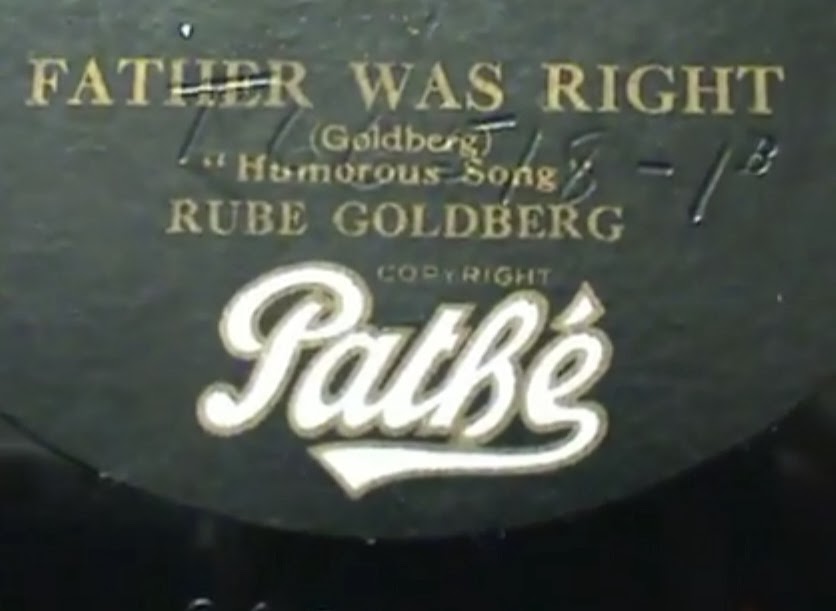
Presenting the earliest known recording, by far, of Rube Goldberg's voice. In 1917, Rube Goldberg sang on a record. The song, which he also wrote, was "Father Was Right." I'm pleased to present this rare recording to you, with some background information.

At the time he made this novelty record, Rube Goldberg was 35 and one of the the most respected and beloved cartoonists in America. His fame and widespread popular acceptance allowed him to expand his talent and humor beyond the printed page. In 1910, he started a five-year career as a stage performer on the east coast Vaudeville circuit.  He appeared as himself, and drew cartoons to amuse audiences. In 1914, he produced, wrote, and starred (again, as himself) in a Vitagraph film, "He Danced Himself to Death."

Rube also had a musical side. In 1912, he published "I'm the Guy," a popular song that was based on his hit comic strip of the same name. In the years that followed, Rube would write and publish many songs. Some of these were recorded by name artists, such as Rosemary Clooney (who recorded "Willie the Whistling Giraffe" in 1951, a song co-written by Rube Goldberg and C.F. Patterson -- the wife of Rube's friend and fellow cartoonist Russell Patterson ).
January 4, 1918 -- This advertisement featured Rube's record

The only known instance of Rube himself creating a commercial recording of one of his songs is the 1917 Pathé record, "Father Was Right." The actual sheet music was published in 1916, and featured original Rube Goldberg cartoons:

Front cover of sheet music by Rube Goldberg (courtesy Robert Beerbohm)

Back cover of sheet music by Rube Goldberg (courtesy Robert Beerbohm)
The song was based on Rube's cartoon series, "Father Was Right," which he rotated through his daily cartoon space in newspapers with several other series and one-shot comic strips. Rube had a special relationship with his father, Max. His mother died when Rube was very young, and his father, a banker and later the sheriff of San Francisco, raised Rube and his siblings on his own. Rube stayed close to his Dad all his life, visiting often and calling upon him to negotiate his business deals and syndicate contracts.

FATHER WAS RIGHT and I NEVER THOUGHT OF THAT by Rube Goldberg
(April 3, 1918, from the collection of Paul Tumey)
The strip followed the same basic formula each time. In panel one, a father provides his son with sound practical advice. The son ignores it, gets into comical trouble, and in the last panel he comes to realize that "father was right!"

The irony of the strip is that Rube's father wanted his cartoon-crazy son to become a mining engineer, and put him through the University of California for that purpose. Max felt that an engineer was a secure and good living. Upon Rube's graduation, Max pulled some strings and git him a job working the City of San Francisco, designing their sewer system (imagine that!). After six months, Rube could no longer contain himself and squirted out of his well-paying job into a career as a newspaper cartoonist at a substantially reduced salary -- in effect ignoring his father's career advice. Of course, you know the rest of the story -- Rube became a huge success. In fact, when he recorded "Father Was Right" in 1918, he had a millionaire's salary, in today's money.

The "Father Was Right" comic strip saw heavy rotation in 1917 and 1918. Rube also created a companion strip, "Mother Was Right." This one ran much less often. "Mother Was Right" was always drawn in silhouettes -- the only strip in which Rube Goldberg used this visual approach. Perhaps it was Rube's way of acknowledging his mother, Hannah, who had tragically passed away at age forty-four when he only nine years old. 


The 1917 Pathé recording of Rube singing is priceless. We are indebted to "MusicBoxBoy," the collector who made this available at YouTube. Unfortunately, Rube was recorded poorly, and the production standards for making the Pathé discs were considerably less than perfect. However, with some concentration, it's not too hard to make out the words Rube is singing-talking. 

It's worth the effort to listen closely through the hiss and pops, because Rube delivers a richly comic performance. He's not a trained singer, and the song lacks aesthetic beauty -- but as comedy, it's golden. Rube adds a layer of humor beyond the funniness of the lyrics by starting out with a great, big, rude, mock throat clearing. Between verses, he repeats the throat clearing, at one point muttering an aside: "I'm suffering as much as you." Then, the act of saying this has thrown his timing off and he stops in mid-word, and says dryly, "wrong again" and waits until the music comes around the right place before he starts in on the last verse.

We can also spot Rube recycling some of his material as he uses a verse from this song in his October 11, 1926 daily strip, shown below. Luke, of "Luke and His Uke" usurps a piano performance of a Beethoven composition, as he sings: "His wife's relations came to eat/In droves of tens and eights/And so he said, "I guess I married/The whole United States." A person in the audience exclaims, 'Wot a talent!" Rube may have been poking fun at himself with this in-joke, since his one commercial performance as a singer, while quite funny, probably never made Caruso break out in a sweat.

Cartoon Follies of 1926 by Rube Goldberg (October 11, 1926)

All in all, this is a wonderful find, and I'm pleased to bring it to you. Herewith, without "father" ado,  is Rube Goldberg's 1917 recording of his song, "Father Was Right," with the lyrics transcribed below. 


Written and Sung by Rube Goldberg (Pathé Records, 1917)

[Clears throat]
When I told my Dad 
That I made up my mind to wed
"Pick out a girl," he said
"Whose relatives are dead."
Little did I know the wisdom of my dear old Dad
I didn't wed an orphan,
But I wish to the Lord I had!
Father was right
Father was right
My wife has cousins by the dozen
(line garbled)
They all get here at supper time 
And bring their appetites
They wear out all our spoons and plates
They come in droves of tens and eights
I married the whole United States --
Father was right!

(Throat clearing - aside: "It's getting worse")
One day I told my Dad I'd like to own a motorcar
He puffed on his cigar
And said, "You won't go far"
I bought a car to show him that I knew a thing or two
I said goodbye and turned the crank 
And that's the last I knew...
Father was right
Father was right
Now my flivver* has my liver
Twisted out of sight
And when I hear an auto horn
I want to start a fight
My back is stiffer than a board
The springs have cut me like a sword
Does anyone want to buy a Ford?
Father was right!

(Throat clearing. Aside: "I'm suffering as much as you")
One day I -- (realizes he is out of synch with music - Aside: "Wrong again")
Father said move to the country where the zephyr blows
For quiet and repose
Where they have no picture shows
Now I know that father wasn't talking through his hat
There's a moving picture theater right beneath our little flat!
Father was right
Father was right
Now my family's at the movies morning noon and night
My wife's so used to darkness, I'm afraid to make a light
Her only friends are on the screen
Instead of good old Pork and Beans
She seized me movie magazine (?)
(clears throat) Ahem! Father was right

*Early 20th century slang for a car that delivers a rough ride

(Throat clearing) In -- ahem -- other news, the new book THE ART OF RUBE GOLDBERG (which has my editing and writing in it) has been getting gangbusters press and flying off the shelves. It's appeared on numerous top 10 lists. This little-known little rag called The New York Times did a wonderful piece on the book, which includes a very clever and fun video they made especially for the online article. It's great to see Rube in the public eye again!

That is All,
Screwball Paul

Saturday, November 30, 2013

The Rube Abides: Thanksgiving 1915

In 1915, Rube Goldberg was on fire as a creator. The satirical subjects and the grotesque imagery that he poured into his ever-shifting kaleidoscopic array of daily comics from about 1915-1917 are among his best work.

Astonishingly, nay... shockingly, most of these great comics have not appeared in print or screen since their original appearances, nearly 100 years ago. How can this be?

A dream project would be to reprint the complete 1915-1917 daily comics of Rube Goldberg, in sequence. It is only then that this seminal screwball master will assume his rightful place in culture as something more than the guy who made goofy, over-complicated inventions to accomplish something trivial. Aside from that, it would be pure fun to read such a collection. I have managed to gather most of the daily comics from 1915 to 1917 in their original published form, and I can assure you that almost every day offers something delightful.

As I write this, it is the weekend of the Thanksgiving of 2013. In between cooking and attending to guests, I have found a few minutes to dig into the archives and sift out Rube's comic for Thanksgiving, 1915. It's a delicious main course, presenting a turkey-carving training school that Rube calls "The Ambidextrous Society."

November 25, 1915 (from the collection of Paul Tumey)

Note that the students are training to carve the turkey left-handed. Rube himself was ambidextrous. He drew with his right hand, but golfed as a lefty. In fact, he published a humorous essay in 1924 called. "Left Handed Golf Courses: Our Greatest Need."

What makes the cartoon above succeed, as far as I am concerned, is the strong composition. The carvers almost look a like machine assembly line. Look at the face and body language of each of the seven men in the strip -- each is different, unique, and funny. When you read the text in the speech balloon and the signs on the wall, it presents a dryly understated comedy that contrasts with the extreme visual-physical comedy of the drawing. This contrast provides a richer reading experience, with two styles of humor offered.

Rube had a 16 x 13 inch space to fill Monday through Saturday. This is a lot of room, practically the space allotted in newspaper fifty years later for ALL of their daily comics. While he had some series, such as "Foolish Questions," and "Father Was Right," that he would repeat sporadically, Rube also drew numerous one-shot comics. Sometimes they were a large single panel, and other times times they were broken up into a complex matrix of panels, or smaller comic strips. To add to our main course, here are two tasty Goldberg side dishes from the month of November, 1915 -- picked almost at random:

November 6, 1915 (from the collection of Paul Tumey)


November 26, 1915 (from the collection of Paul Tumey)


Pretty swell stuff, if you ask me. And -- certainly worth a second life, especially in this golden age of comics publishing.

Speaking of comic publishing, the new book THE ART OF RUBE GOLDBERG, selected by Jennifer George that has just been published is doing well. I feel so honored to have been a part of that project. It's charting as a #1 bestseller on Amazon in the Comics and Manga category. Legendary mail order guru and tastemaker Bud Plant (visit his site, here) featured it in his latest email catalog and gave it a "highly recommended" note (thanks, Bud!). I've been buying books and comics from Bud Plant since the 1970s, so it's truly a thrill to be in his catalog!

Here's some other cool links related to the book:

'Art of Rube Goldberg' More Than Crazy Contraptions -- LA Times (I'm gratified to see they got the book's goal to show ALL of Rube's work, including the celebrated invention cartoons)

Design Books by Chipp Kidd -- The Wall Street Journal (I'm excited to see that two of the six books Mr. Kidd recommends have my work in them -- The Art of Rube Goldberg and Society Is Nix.)

Photos from the book party for The Art of Rube Goldberg (with Jennifer George, Al Jaffee, Brian Walker, and Andrew Baron in attendance)

Pinterest Board for The Art of Rube Goldberg (with lots of gems plucked from my archives)

A TV interview with Jennifer George (Rube Goldberg's granddaughter and the author of The Art of Rube Goldberg)


The book also received favorable short reviews in Wired and Boing Boing.

That is All (for now),
Paul Tumey


Friday, November 15, 2013

Rube Goldberg's Drawing Board, My Feet, and The New Book

It's official! The deluxe, super-sized book, THE ART OF RUBE GOLDBERG is available for purchase wherever fine books are sold!

After two days on the market, the book has skyrocketed to the #1 bestseller in Amazon's "Comics and Manga" section!

I personally am very proud of this volume, having put a lot of work into it. I am greatly honored to be a part of this project. The book contains three essays by me, and about 25% of the contents come from material I supplied.  I helped select much of the contents and wrote at least half the captions, some of which are little mini essays in themselves. I also created all of the back matter: a Rube comicography, bibliography, and timeline -- all of which are by far the most complete and accurate versions available.

But that's just a part of this huge project. There's also original essays about Rube and work by the legendary Al Jaffee, comics historian (and writer of the Hi and Lois comic strip ) Brian Walker, Sunday Press curator Peter Maresca, comics scholar and collector Carl Linich and  more. The best stuff are the essays by Rube's granddaughter (and the books author) Jennifer George -- you get a sense of Rube as a person more than anything else that has ever been written on him. And the whole package is thoughtfully assembled and beautifully produced by the great folks at Abrams, led by Charles Kochman.


There's a ton of comics, art, and photos in this book. In fact, there's some spectacular photography by Geoff Spear, who you may know from other fabulous books like Chipp Kidd's Peanuts: The Art of Charles M. Shulz. In one page, we see Spear's photo of Rube's drawing table. The lighting and angle of view reveal the many indentations and scars created from over 65 years of use.

My own photo of Rube's drawing table, taken in New York. You can see the arm of the futon frame in the photo.

I actually got to see this drawing table when I spent a week in New York City in August of 2012 working on this book. Jennifer George graciously put me up at her place for a few nights and this drawing board is in her living room. I asked Jennifer how long Rube used this table for, thinking that perhaps it just one of many he had. She said, "As I understand, this was the one." And indeed, you can see the very same drawing table in early photos of Rube. This historical cultural treasure was located at the foot of the futon on which I slept. On occasion, during the nights I slept there, I would stretch my legs in my sleep and my bare toes came into contact with the surface of Rube's drawing board. I remember waking up a few times with an electric jolt when I realized I was barefooting Rube Goldberg's drawing table. Sorry, Rube!

I personally am very proud of this volume, having put a lot of work into it. When I was 14 years old, I read Peter Marzio's book, Rube Goldberg: His Life and Work (Harper and Row, 1973).  Unlike most folks who associate Rube Goldberg with nutty inventions, I imprinted upon his inexhaustible fountain of creativity and lyrical smart-assness. To me, the spirit in which Rube created his comics is in direct lineage with the same spirit that inspired the Underground Comix of the 1960s and 1970s, and the self-published Newave comics of the 1980s and 1990s. Many people can trace the cultural lineage of these modern comics movements back to Will Elder, Harvey Kurtzman and the Mad gang, but rarely further back. Rube Goldberg, who started his cartooning career in 1904, is just too far back in the mists of time for most folks to see his connection to comics today - but it's there, make no mistake. After all, Harvey Kurtzman drew Rube's characters Mike and Ike on city sidewalks when he was growing up -- his first cartoons.

Smile, boys! Paul Tumey (r) with Carl Linich (l) to sift through the Jennifer George archives and extract gems for THE ART OF RUBE GOLDBERG. Oh, if I could only share with you all of the great stuff I saw!

It doesn't help that there has never been a decent book on Rube Goldberg that presented his work in all its varied richness and brilliance. When Rube was alive there were only a scant handful of books that reprinted just a tiny fraction of his comics, such as the 1909 Foolish Questions book. After his death, the emphasis has been on his invention cartoons. These cartoons are indeed brilliant and sell books -- but to just present this part of Rube's work to the public is like only showing the world Picasso's Cubist works. There's so much more to explore, appreciate, and embrace. There's never been a book that attempted to cover all aspects of Rube's career -- until now. The Art of Rube Goldberg has a healthy sampling of the inventions, but there's tons of other cartoons, photos, articles, and items that reveal the fullness of this astonishing body of highly influential work.

A few months ago, to help promote the book, I created a three-minute video using some of the great art to be found in the pages of this extraordinary compendium. For the music, I used an old Public Domain 78 recording of a song that Rube Goldberg actually wrote, "I'm The Guy." The publisher, Abrams, liked the video, but didn't want to give away so much yet about the contents, so the project was shelved. Now that the volume is officially released, and on the market, I'd like to share this video with the loyal readers of this blog. Enjoy!


That is all,
Screwball Paul

All text and proprietary photos copyright 2013 Paul Tumey.

Saturday, November 9, 2013

A Week of Rube Goldberg's 1918 Comics Featuring Mike and Ike

In just a few days from the time this post is being written, the brand new, deluxe art book entitled The Art of Rube Goldberg (selected by Jennifer George, Abrams ComicArts, 2013)  will be available for purchase. As my friend and colleague in the book's creation, Carl Linich recently put it, "There has never been such a rich and thoroughly representative collection of Rube's work."

The book contains hundreds of rare cartoons and art by Rube Goldberg -- the majority of which have not seen the light of day since their original appearances as much as 100 years ago. There's also lots of cool photos, original art, and items selected from the Goldberg family archives.

This large, thick compendium is stuffed with work from many gifted folks, including some wonderful essays from Jennifer George, Rube's grand-daughter (and the CEO of Rube Goldberg, Inc.). There's an in-depth intro (not just a puff piece) by world-famous arty guy Adam Gopnick, and original essays created just for this book by comics legend Al Jaffee, Brian Walker, Pete Maresca (of Sunday Press), Carl Linich, and Andrew Baron (who created the book's paper engineered movable art cover).

I am quite proud of my own contributions to the book. In addition to doing some editing work on it (with Charles Kochman), and wrangling about a quarter of the book's content, I was able to buckle down and do some serious writing and comics scholarship on this bad boy. The book contains my essay exploring his Foolish Questions cartoon panel and my essay on his 1916 animated cartoon series. It also contains my 12-page survey of Rube Goldberg's comic strips of the 1920s and 1930s, "Restless Storyteller."


The book also contains my Rube Goldberg Timeline, list of his comic strips (this took 3 months of intense daily work to research, and I probably still missed some comics), and a list of his published writings. I've been studying and writing about comics for years, and this marks my first "big time" publication. Needless to say, I'm thrilled to be a part of it!

Paul Tumey beams, holding a copy of The Art of Rube Goldberg

I plan to write a column about the making of the book and some things I've learned about Rube Goldberg and comics in the next installment of Framed!, my monthly column at The Comics Journal. You can see a nice preview of several interior pages from the book, here. 

As jam-packed with screwball comic goodness as The Art of Rube Goldberg is, there's a lot of great material and ideas for sections that we weren't able to get in, due to space restrictions. One idea we wanted to do was to reprint a entire week of Rube Goldberg dailies. The idea was to recreate for our readers the Monday-through-Saturday context of Rube's work -- which has been largely lost. From 1909 to 1927, Rube's daily comic strip featured something new and different every day. He had a number of series, such as Mike and Ike, Foolish Questions, and The Weekly Meeting of the Tuesday Ladies' Club, that he rotated,  more or less randomly (although the The Weekly Meeting of the Tuesday Ladies' Club did actually run on Tuesdays). Today, when we think of a comic strip, we automatically think of a continuing series with continuing characters, like Nancy, Pogo, L'il Abner, Popeye, Blondie, Dilbert, Garfield, and so on. Rube Goldberg was different. From Monday through Saturday for years, he filled his rectangular space on the newspaper page with a dazzling variety and comic richness that remains unmatched. For the most part, Rube didn't create his comics around characters, but instead around ideas -- such as our confounding propensity to ask questions when the answer is right in front of us.

Because most books on Rube, The Art of Rube Goldberg included, present a selection of his comics and not the whole she-bang, the impact of Rube's kaleidoscopic komedy is lost. It's only a matter of time before a savvy publisher reprints a full year of Rube's work, and people will realize just how inventive this cartoon genius was. In the meantime, here is an "outtake" from The Art of Rube Goldberg, a full week's run from the first week in April, 1918, created from paper scans of items in my own collection. 

For much of 1918, Rube featured in his daily strips, his dubious doppelgangers, Mike and Ike. These are perhaps Rube's longest-lived characters, having been created for Rube's very first Sunday comic in 1907, The Look-a-Like Boys. Later in 1918 -- after our sample week -- Rube dabbled with the idea of continuity in 1918 (something I wasn't aware of when I wrote my essay about his continuity comics for the book -- it was only when I purchased a set of strips from 1918, after the essay was already completed and sent to the printers,  that I realized this), sending the boys to Europe to fight in the last days of World War One. Here, we have perhaps the quintessential example of the strip, with the boys running to meet their elusive maker so they can finally learn their true identities-- an early comic strip version of Waiting For Godot. Note the date: April 1, 1918.

Monday: April 1, 1918 (from the collection of Paul Tumey)

On the next day, Rube offered an installment of The Weekly Meeting of the Tuesday Ladies' Club. This large, single panel cartoon ran on Tuesdays from May 1, 1917 to September 27, 1921 (I'm proud to be able to offer this date range -- it took me days of research to figger dis out!). There's a large section of this lost gem from Rube's oeuvre in The Art of Rube Goldberg, introduced by his grand-daughter, Jennifer George. The strip is one of Jennifer's favorites, and mine too. 

Rube developed his new strip from his observations of his new bride's social gatherings. By today's standards, some of the gags might be considered insulting to women, but in actuality, they are simply insulting to silly, stupid people. Nearly everything Rube created falls into that category. 

The example below is typical: a meeting in which the Ladies have invited a guest to enlighten them upon a subject. In this case, it's constitutional law. To fully appreciate this strip, it's important to realize that the United State's Women's Suffrage Movement was going full-strength  in 1918. President Wilson had proposed that American women should be allowed to vote (the measure didn't pass until 1920). So, part of the joke here is that the Ladies are preparing themselves to soon cast their first votes. 

On another note, pay attention to the various silly names of people and things: Professor Stall, Bink vs. Bink, and so on. This is one of the pleasure of reading Rube Goldberg, who had an ear for nonsense sounds like few other cartoonists.

Lastly, note that this Tuesday strip offers an entirely different layout than the Monday strip. In fact, the Tuesday offering is actually comprised of two different comics. Slackers was a panel series that Rube created regularly during this period. Often, there's a thematic connection between the comics in Rube's sub-divided properties. In this case, both strips offer perspectives on the battle for power between the sexes. 

Tuesday: April 2, 1918 (from the collection of Paul Tumey)

On the following day, Rube created an episode of Father Was Right,  yet another of his randomly presented series. This series ran sporadically from 1915 to 1921. Rube had a close and admiring relationship with his father, Max Goldberg. Thus, once again, we see that Rube drew from his own life to develop his comic properties. Note also that, once again, we have an entirely different layout concept from the previous two days. Monday offers a straight-no-chaser 5-panel strip. Tuesday gives us two panel strips, with one being quite large and detailed. Today, we receive two multi-panel comic strips -- one large, one small. The small strip, I Never Thought of That, was also a stock player in Rube's inventory of semi-regular features. Even though neither of these examples in the Wednesday slot are exceptional, they do offer Rube's genuinely funny takes, in panel 5 of Father Was Right, and panel 4 of I Never Thought of That.

Wednesday: April 3, 1918 (from the collection of Paul Tumey)

The following day, Thursday, Rube treats us to another Mike and Ike. This time, one tried to get the better of the other, and fails -- as usual. The gag about Mike wearing out his brain trying to figure out the situation in Russia is both a topical reference, and a nicely absurd excuse.
Thursday: April 4, 1918 (from the collection of Paul Tumey)


Rarely did a week go by in the first half of the twentieth century without a Rube Goldberg invention of some kind appearing in America's newspapers. In addition to the A-B-C chain reaction diagrams, Rube also worked inventions into his work in numerous ways. In his Friday offering, he provides a three panel sequence, demonstrating the use of his "Newsdealer's Cure."

Friday: April 5, 1918 (from the collection of Paul Tumey)

Rube rounds the week's output off with another Mike and Ike and a classic Goldbergian drawing of an absurd car crash that reminds me of the slow-motion automobile pile-up from Jacques Tati's Traffic.

Saturday: April 6, 1918 (from the collection of Paul Tumey)

Whew! In just one random week, Rube gives us nine different comics in a dizzying variety of layouts that comment on human nature, technology, war, women's rights, and identity itself. You can take similar petri dish samples of Rube Goldberg weeks from other years and get entirely different mixes of different strips and themes, but the creative brilliance is always present!

BONUS! You can read a great interview with Abrams ComicArts' Editorial Director, Charles Kochman (and the co-editor of The Art of Rube Goldberg) here.  The existence of this book is due in large part to Charles Kochman's vision and drive to make it happen.

BONUS TOO!
Rube clip from Edward R. Murrow's "Person to Person" from March 1959. He is seated with his wife Irma.


Screwballingly and Enthrallingly Yours,
Paul Tumey


Sunday, August 25, 2013

What Is Art? - A Milt Gross Count Screwloose From 1931 Frames The Question

When you ask yourself questions like "what is art," you are probably setting out on the path that leads to the fruitcake factory. Enuff books and articles have been published on this subject to fill several buildings -- and it would appear that we humans are no closer to an answer we can all agree on than we are to finding a use for screen doors on submarines.

Are comics art? I think so -- some comics, at least. The funny thing is that many comics creators (and I'm talking sequential narratives, here) appear to have been aware that their fellow humans regarded their hard work as innately inferior to the stuff that wound up on the walls in galleries. For many -- even today -- reading comics isn't actually reading -- and comics are associated with illiteracy and simple-mindedness. When someone wants to say something is shallow, they say it's "a comic book treatment." These commentators are only betraying their own ignorance -- for comics are an art form that combines words and image into a highly effective language that may be easy to grasp, but is anything but simple to create.

Many comics creators over the decades have used society's disapproval as grist for their mill. Here's a Rube Goldberg cartoon, circa 1915, in which he suggests the best way to view the new abstract and surreal art appearing in galleries and museums.

Rube Goldberg on modern art - circa 1915
(Photograph of original art)

Milt Gross -- who in many ways is the direct artistic and screwball descendant of Goldberg -- also made sport of the idea of art many times. In a 1931 Count Screwloose Sunday page, Milt Gross dissects for us the mechanics behind the social value of art. In this case, a bum who attempts to get a drink in a bar by reciting a poem receives the comic blow of a pool table on the head. When the same bearded bohemian beggar appears at a society ball clad in his hospital sheet, the wealthy party-goers celebrate his "art." The entire absurd -- but all too true -- situation is witnessed by Count Screwloose:

Count Screwloose by Milt Gross - February 22, 1931
The poem the beggar-poet recites is a very popular poem written in the 1830s entitled Abou Ben Adhem. The author, (James Henry) Leigh Hunt (1784-1859) was an English poet, essayist, and critic -- and a contemporary of Shelly's. His poem -- a depiction of a Muslim written by a Christian that expresses, in the opinions of some, basic Jewish values was a popular hit. Here's the entire text:

Abou Ben Adhem (may his tribe increase!)
Awoke one night from a deep dream of peace,
And saw, within the moonlight in his room,
Making it rich, and like a lily in bloom,
An angel writing in a book of gold:—
Exceeding peace had made Ben Adhem bold,
And to the presence in the room he said,
"What writest thou?"—The vision raised its head,
And with a look made of all sweet accord,
Answered, "The names of those who love the Lord."
"And is mine one?" said Abou. "Nay, not so,"
Replied the angel. Abou spoke more low,
But cheerly still; and said, "I pray thee, then,
Write me as one that loves his fellow men."


The angel wrote, and vanished. The next night
It came again with a great wakening light,
And showed the names whom love of God had blest,
And lo! Ben Adhem's name led all the rest.

Gross' inclusion of Hunt's poem, a chestnut by the 1930s, carries an ironic comment on the actions of his characters in the strip -- neither the pool hall ruffians not the society folks actually show any love at all for the beggar himself. Of course, as Sigmund Freud observed, nothing is less funny than analyses of jokes -- so I'll stop here and encourage my readers to simply dig those great, loose drawings in the strip above.

As to the issue of cartoons, art, and such -- I offer this from the great cartoonist Art Young (1866-1943):

"Some day painting will be glorified cartooning... The painter-cartoonist of the future will be an apostle of big ideas... That he will be an artist of pigment and form is, of course, important; but to be a thinking man of vision, helpfulness and courage, will be more important." (from On My Way by Art Young, 1928)


Artfully Yours,
Screwball Paul

Thursday, July 4, 2013

Rube Goldberg's 1918 Fourth of July Cartoon - War and Pieces

Happy Fourth of July, 2013!

As you probably know, Rube Goldberg was born on July 4, 1883. To my knowledge, Rube never trumpeted his own birthday in his daily cartoons, but he always seemed to make a special effort in his work for the Fourth.

To celebrate the 4th and Rube's birthday, I've scanned from my own collection his strip from July 4, 1918, which features a surprisingly nice pen-and-ink sketch of Uncle Sam, and a really funny gag panel drawing of two kids wary about lighting a giant firecracker. The original strip measures 15 inches across -- which was Rube's regular space allotment in newspapers from 1909 to about 1920, or so.

The cartoon I have for you today needs a little context. In July, 1918 the United States was deeply involved in World One One, also known as "The Great War." The war had been going on for nearly four years. It would end just four months after Rube penned this cartoon. Nine million soldiers died during the conflict, and many more were maimed and psychologically damaged. This war saw technological "advancements" in weaponry that led to horrific carnage.

Ernest Hemingway was an ambulance driver in the conflict, in Italy when this cartoon came out. He was seriously wounded and sent home. Hemingway's first published novel The Sun Also Rises (1926), is centered on a character who is impotent and emotionally destroyed after serving in the war. His 1929 novel, A Farewell to Arms is drawn from his experiences in WWI.

Rube's stock-in-trade was screwball humor and funny drawings. It must have been a challenge for him to figure out how to fit his work into a bloody, deadly serious conflict. In the case of his July 4, 1918 cartoon, he eschewed humor (mostly) and delivered a sprightly editorial cartoon, abutted by a holiday-themed episode of one of his panel series, Slackers:

July 4, 1918 - Rube's cartoon from the final months of WWI
That's the German Kaiser portrayed on the left. Rube had been cartooning about the Great War since the conflict's first days, in 1914.. In fact, he began as an unplanned observer on the front lines. In 1913, Rube had made his first successful tour of Europe (paid for by his newspaper employer, The Evening Mail) and dispatched a series of popular cartoons, "Boobs Abroad," humorously recounting his experiences. Rube was probably feeling on top of the world in the summer of 1914, the following year, when his paper again sent him on an all-expenses-paid tour of Europe. Everything was going as planned until, a few weeks after his arrival, World War One broke out.

Rube changed the subject matter of his cartoons and columns sent back home from the light-hearted experiences of a tourist to that of a humorist observing the chaos and confusion of a war's early escalation. The result was a remarkable series of cartoons, such as this one, entitled "If You Are On The Ground, Naturally You Can Understand The War Situation More Thoroughly."

Rube Goldberg reports from France during World War One, 1914
These cartoons were collected into a book, with some of Rube's Twain-like prose writing. The book, more of a pamphlet at 32 pages, was called Seeing History At Close Range: The Experiences of An American Cartoonist Marooned In France During the Outbreak of the Present War. Rube was into really long titles around time.

In the book's introduction, Rube makes it clear that he had no intention of minimizing the horrors of the war."In preparing these stories and cartoons I have never for one instant lost sight of the tragic side of this terrible conflict which has brought sorrow to the hearts of thousands of good people in the warring countries."

He goes on to write, "If I succeed in drying a tear or two without sacrificing the ideals of human feeling I shall be able to look the Statue of Liberty in the face and write her telephone number down in my little red book."

Rube was stuck, for a time, in the midst of the conflict in France. He needed to produce official documents to the military authorities in order to return to the United States, and he had none. Finally, in desperation, he brandished a dentist's bill he found in a suitcase, and managed to pass it off as an official government document, which resulted in his safe passage home.

In the next few years, Rube worked tirelessly to raise money for the war effort, often performing the sketch act that he perfected in his Vaudeville tours. He returned to Europe just three months after the war ended and, on February 29, 1919 published a column (few realize that for much his career, Rube penned a newspaper column as well as daily cartoons)  in which the great humorist allowed himself a moment of sober reflection:

"I can add little to the numerous camera and word pictures you have seen so often. But there is one thing that the camera cannot give you. It is the choking sensation you get when you see a small wooden cross alongside the road out there in the wilderness marking the spot where one of our boys gave all he had to give to keep the rest of us clean and free."

February 28, 1919 - Rube Goldberg write in his column
a heartfelt and sober reflection on war
Years later, in 1938, Rube moved from his daily humor strips to become a Pulitzer-Prize-winning political cartoonist. As we see here, he was unafraid to step away from humor once in a while earlier in his career and pen a patriotic war-themed cartoon for the Fourth.

For more of Rube's Fourth cartoons, see last year's article on the subject: Rube Goldberg On The Fourth of July.

Shameless Plug Department: I have begun a new column, Framed!, for the online magazine, The Comics Journal. My first column is called The Lost Comics of Jack Cole - Part One (1931-38). I invite you to check it out.

Happy Independence Day,
Paul Tumey

Tuesday, June 11, 2013

Rube Goldberg's Cartoon Machine Inventions of 1913


About 10 months passed between the production of Rube Goldberg's first and second invention cartoons, from July 17, 1912 (view that cartoon here) to May 7, 1913. As with the first cartoon, Rube's invention solves a minor insect-related problem.

May 7, 1913 - by Rube Goldberg
From this point on, the inventions occur more frequently. Rube's second invention, The Asparagusometer, doesn't actually solve a problem -- it's merely a comic way of eating asparagus.

June 11, 1913 - by Rube Goldberg

Rube's fourth invention cartoon carries a series title: Great Discovery. The typeface matches other series of that year, such as Breaking Even.

Breaking Even and I'm The Guy by Rube Goldberg - September 22, 1913

With the fourth invention, the approach has become more refined, looking more like a precisely drawn patent application drawing. Note that this nonsense invention is not purely mechanical -- it relies on the politeness of a beer bottle...

December 18, 1913 - by Rube Goldberg
The experimental series title suggests that, with the second invention cartoon, Rube had decided he'd like to create these as an ongoing series. One wonders if he realized he would be creating these ingenious cartoons for the next 50 years. This was the only time Rube used this series name. It's a mystery as to why Rube didn't continue the series title (other than that it's a little lame).

In an alternate universe, Rube Goldberg Machines are called "Great Discoveries." I think Rube came out better in our universe.

Coming in November, 2013:


I co-edited this book and contributed three essays on the great cartoonist. Available here from Amazon - a great pre-order deal!

That is all,
Screwball Paul Tumey