Saturday, July 28, 2018
Deluxe New Screwball Comics Retrospective Coming Soon!
Screwball! The Cartoonists Who Made the Funnies Funny is in the works! It will be a large, full-color hardcover art book offering around 275 pages resplendent with rare comics, art, photos and original research. I've got the fantods, since this is my first book and I really hope folks like it!
The story of screwball comics in America is a large topic, more sprawling than one book can reasonably encompass if one wishes to present satisfying chunks of reprints. Foo this reason, I decided, after much deliberation, to narrow the focus of this book on American newspaper comics up to about 1950.
The publisher will be The Library of American Comics/IDW. Eisner-Award winner Dean Mullany will design and edit the book, with Bruce Canwell and Lorraine Turner providing their expertise, as well.
We are creating a retrospective that will be broad and deep. There will be 15 chapters, each one focusing on a particular cartoonist or comic strip with an in-depth text essay and an assortment of carefully curated strips, art, and photos.
As of this writing, and subject to change, here is the list of chapters, in the order they will appear:
Frederick Opper
Eugene "Zim" Zimmerman
Walter R. Bradford
Clare Victor "Dwig" Dwiggins
Gus Mager
George Herriman's Stumble Inn
Rube Goldberg
Walter Hoban
E.C. Segar
Milt Gross
Gene Ahern
George Swanson
Ving Fuller
Bill Holman
Boody Rogers' Sparky Watts
Saturday, December 24, 2016
Rube Goldberg Wishes You a Merry Christmas
Over the course of his 35 years or so as a daily and Sunday newspaper humor cartoonist, Rube Goldberg celebrated many Christmases in pen and ink. Here is a selection of just a few of his Christmas-themed offerings.
1909 - December 25
Goldberg's first hit comic was Foolish Questions, which debuted in 1908. It catapulted him into national fame. The basic idea is that someone is asking a painfully obvious question and usually there is a sarcastic, surreal reply. At least one newspaper ran the following on Christmas day, 1909:
1911, December 25
Santa takes a well-earned rest
1922, December 21
1922, December 22 - Life's Little Jokes
A semi-regular series Goldberg created in the early 1920s
1923, December 24 - Steve Himself
Yet another short series Goldberg ran
1924, December 22 - Bozo Butts
For a summer job in college, Rube Goldberg collected patients and drove them to the San Francisco insane asylum. He was one of the "men in the white coats." Perhaps he drew on that experience for this short series.
1924, December 23 - People Who Put You To Sleep
One of my favorite series of Goldberg's -p- always makes me laugh, Lamp that guy asleep on top of the speaker!
1925, December 24 - Life's Little Jokes
1927, December 24 - Bobo Baxter
In late 1927 and for most of 1928, instead of rotating his short series randomly among his many one-shots, Goldberg briefly settled down with one single comic strip, about a wacky inventor who creates a flying bicycle. This is the visually appealing Christmas episode.
Sunday, September 21, 2014
The Comic Writing of Harry J. Tuthill in The Bungle Family
Let's be honest: Harry J. Tuthill's Bungle Family comics are extremely wordy. This can be daunting. It takes some work to read all those words. If you try to read his comics the way you might read a modern comic strip, you won't enjoy them. However, if you can get on Tuthill's wavelength, he will take you to some great places.
Harry Tuthill's writing during the peak years of The Bungle Family in the 1920s and 1930s, is, for my money, is some of the best to be found in American comics. His satirical vision of America is subversive and deliciously dark. The dialogue could stand on its own, or easily be translated into a screenplay.
It was no real surprise to me to discover, while researching my introduction to a Bungle Family Tuthill had a stint writing for radio. I dug up little-known information about how Tuthill was hired by Proctor and Gamble to write a daytime radio serial based on The Bungle Family. Sponsored by a soap company, the show was called The Puddle Family. Before he diluted his own career as a successful radio writer by, according to some, demanding too much money, Tuthill -- it could be said -- wrote one of the very first soap operas.
Much like characters from a typical soap-opera, the people in Harry J. Tuthill's misanthropic screwball masterpiece, The Bungle Family (1918-1945), hear only their own voices. Husbands and wives talk at, not to, each other. Friends and neighbors appear to be having a chat, but they are only covering up their own uncharitable thoughts, which they have just barely enough awareness to know are socially unacceptable. People pass by in the background, muttering to themselves. No one sees the other -- everyone is lost in themselves. This is screwball comedy writing on a whole 'nother level, folks. Once you immerse yourself in it, it's quite funny. This darkly comic vision transforms simple events into a comic opera, such as the visit of friends at George and Josie Bungle's home, sweet home.
Recently, a year of Bungle Family dailies was published in the IDW Library of American Comics Essentials series. The book, The Bungle Family 1930, was edited by Dean Mullaney and features an introduction by me (Paul C. Tumey) that reveals the curious story of Harry J. Tuthill.
While the dailies of the comic strip presented serial stories that went on for weeks and months, the Sundays were self-contained. At their best, these pages were the comic strip equivalent of a half-hour sitcom, filled with richly funny dialogue. In fact, Tuthill's sardonic writing anticipates the currently popular "comedy of discomfort" we see in acclaimed TV comedies like The Office and Parks and Recreation. Tuthill, who lived his life as a sort of outsider, had no compunctions about skewering the American dream. His depiction of lower middle class life in 1920s and 1930s America is nasty, mean, and hilarious because it's true.
In this Sunday page, from 1926, we see a particularly potent example of the comic writing of Harry J. Tuthill. Note how he sets up the scene in the opening "credits" in the top banner, which presents the original name of the series (various papers shifted from 'Home, Sweet Home" to "The Bungle Family" at different times in the mid-1920s). Some friends are visiting George and Josie. The comedy in this page works on different levels. There's the good-hearted naivte of George and Josie as they mistake the behavior of their acid-tongued friends for kindness, This is especially interesting, because at other times, it's George and Josie who are grousing and ill-tempered.
Then there's the litany of petty complaints issued forth from the mouths of the "friends." They find fault in everything related to the Bungles. Notice the structure Tuthill sets up. Most of the complaining occurs in the second panel of the top three tiers. This creates a rhythm, and also a solid column of comic complaints that sits like the central supporting pillar of the entire page. It's no accident the second panel in the fourth, and final, tier features the oblivious George and Josie -- as a comic coda.
The artwork is, as usual, a thing of wonder. Tuthill's grubby, scratchy style perfectly conveys the coarseness of his characters, who desperately adorn themselves in tacky patterns.
The strip of characters at the bottom of the page is not Tuthill's work -- it is by someone with little ability or talent.
Note also the strip begins with two people in the background, rushing into each other's arms, exclaiming, "Mom!" and "Pop!" One of the many delights of The Bungle Family is that interesting things happen in the background. Check out also the man in the background of panel one, tier three -- petulantly pouting to himself.
In 1998, American Heritage magazine put out a special issue where they asked various people to list over- and underrated works in certain categories. Art Spiegelman was tasked with handling the comic strip category. For "overrated," he chose Dilbert. His choice for most underrated comic strip of the twentieth century? The Bungle Family.
- Paul Tumey
Harry Tuthill's writing during the peak years of The Bungle Family in the 1920s and 1930s, is, for my money, is some of the best to be found in American comics. His satirical vision of America is subversive and deliciously dark. The dialogue could stand on its own, or easily be translated into a screenplay.
It was no real surprise to me to discover, while researching my introduction to a Bungle Family Tuthill had a stint writing for radio. I dug up little-known information about how Tuthill was hired by Proctor and Gamble to write a daytime radio serial based on The Bungle Family. Sponsored by a soap company, the show was called The Puddle Family. Before he diluted his own career as a successful radio writer by, according to some, demanding too much money, Tuthill -- it could be said -- wrote one of the very first soap operas.
![]() |
| The cast of THE PUDDLE FAMILY, a 15-minute, five-day-a-week radio serial that originated from the WLW studio in Cincinnati, Ohio in 1931-1932. (courtesy of Proctor and Gamble) |
Much like characters from a typical soap-opera, the people in Harry J. Tuthill's misanthropic screwball masterpiece, The Bungle Family (1918-1945), hear only their own voices. Husbands and wives talk at, not to, each other. Friends and neighbors appear to be having a chat, but they are only covering up their own uncharitable thoughts, which they have just barely enough awareness to know are socially unacceptable. People pass by in the background, muttering to themselves. No one sees the other -- everyone is lost in themselves. This is screwball comedy writing on a whole 'nother level, folks. Once you immerse yourself in it, it's quite funny. This darkly comic vision transforms simple events into a comic opera, such as the visit of friends at George and Josie Bungle's home, sweet home.
Recently, a year of Bungle Family dailies was published in the IDW Library of American Comics Essentials series. The book, The Bungle Family 1930, was edited by Dean Mullaney and features an introduction by me (Paul C. Tumey) that reveals the curious story of Harry J. Tuthill.
While the dailies of the comic strip presented serial stories that went on for weeks and months, the Sundays were self-contained. At their best, these pages were the comic strip equivalent of a half-hour sitcom, filled with richly funny dialogue. In fact, Tuthill's sardonic writing anticipates the currently popular "comedy of discomfort" we see in acclaimed TV comedies like The Office and Parks and Recreation. Tuthill, who lived his life as a sort of outsider, had no compunctions about skewering the American dream. His depiction of lower middle class life in 1920s and 1930s America is nasty, mean, and hilarious because it's true.
![]() |
| The Bungle Family from October 3, 1926. From the collection of Paul Tumey. |
In this Sunday page, from 1926, we see a particularly potent example of the comic writing of Harry J. Tuthill. Note how he sets up the scene in the opening "credits" in the top banner, which presents the original name of the series (various papers shifted from 'Home, Sweet Home" to "The Bungle Family" at different times in the mid-1920s). Some friends are visiting George and Josie. The comedy in this page works on different levels. There's the good-hearted naivte of George and Josie as they mistake the behavior of their acid-tongued friends for kindness, This is especially interesting, because at other times, it's George and Josie who are grousing and ill-tempered.
Then there's the litany of petty complaints issued forth from the mouths of the "friends." They find fault in everything related to the Bungles. Notice the structure Tuthill sets up. Most of the complaining occurs in the second panel of the top three tiers. This creates a rhythm, and also a solid column of comic complaints that sits like the central supporting pillar of the entire page. It's no accident the second panel in the fourth, and final, tier features the oblivious George and Josie -- as a comic coda.
The artwork is, as usual, a thing of wonder. Tuthill's grubby, scratchy style perfectly conveys the coarseness of his characters, who desperately adorn themselves in tacky patterns.
The strip of characters at the bottom of the page is not Tuthill's work -- it is by someone with little ability or talent.
Note also the strip begins with two people in the background, rushing into each other's arms, exclaiming, "Mom!" and "Pop!" One of the many delights of The Bungle Family is that interesting things happen in the background. Check out also the man in the background of panel one, tier three -- petulantly pouting to himself.
In 1998, American Heritage magazine put out a special issue where they asked various people to list over- and underrated works in certain categories. Art Spiegelman was tasked with handling the comic strip category. For "overrated," he chose Dilbert. His choice for most underrated comic strip of the twentieth century? The Bungle Family.
- Paul Tumey
Tuesday, July 8, 2014
A Toothful Espisode of W.R. Bradford's John Dubbalong (1911)
Yesterday, I had a tooth pulled. I confess, I was quite brave. I went in with nary a protest, and uttered only two groans at the procedure's most intense moments. Yes, friends, my bravery was eclipsed only by the year of avoidance I invested before so courageously arranging myself into the dentist's chair. To celebrate both my hour of bravery and my year of cowardice, I share in this post with you an episode of the daily comic strip John Dubbalong, by screwball master W.R. Bradford.
Walter Bradford worked in newspaper comics for roughly the first quarter of the twentieth century, passing away in June of 1925 at age 53. His thousands of forgotten comics display a remarkable flair for screwball comedy, embracing anarchy, obsession, and insanity. In many ways, his stuff is as "out there" as Milt Gross, and in some ways a great deal screwier. His drawing style is, at first look, rather crude, but it is actually part of a now-forgotten school of comics that George Beckenbaugh (who worked under the name "Percy Winterbottom") in which the crudeness of the drawing is part of the joke.
Even though Allan Holtz's excellent resource, American Newspaper Comics: An Encyclopedic Reference Guide lists 33 comic strips by W.R. Bradford, John Dubbalong is not one of them. As near as I can tell, the strip ran 1-2 times a week from 1911 to 1914. The episodes were very dense, with lots happening in them. At another post, I'll share more of this rich comic strip.
For now, here's a small bite of John Dubbalong. Note the unusually dense story composition, with five scenes in 10 panels (eleven if you count the panel-within-a-panel). The last scene shows dental instruments madly dancing and singing an original song. Bradford was fond of writing silly verse, and built one of his most popular strips, Jingling Johnson around it (Johnson was a self-caricature of Bradford). Mysteriously, we are told the song is sung by a "quartette" of dental tools, but only three are shown -- either a sign of the haste with which the strip was composed, or another joke.
How about that 8th panel, with the Winsor McCay style distortion?
Given Bradford's status as an early master of screwball comics, and the subject matter of this particular example, it would not be inaccurate to say that this posting may qualify as a true "roots" of screwball comics entry -- although it might coax further groans to do so.
P.S.: If you haven't already, be sure to find the accompanying Facebook group to the blog, The Masters of Screwball Comics, and send me a request to join. Lots of cool screwball comics and other neat stuff posted there every day that never makes it to this blog!
Walter Bradford worked in newspaper comics for roughly the first quarter of the twentieth century, passing away in June of 1925 at age 53. His thousands of forgotten comics display a remarkable flair for screwball comedy, embracing anarchy, obsession, and insanity. In many ways, his stuff is as "out there" as Milt Gross, and in some ways a great deal screwier. His drawing style is, at first look, rather crude, but it is actually part of a now-forgotten school of comics that George Beckenbaugh (who worked under the name "Percy Winterbottom") in which the crudeness of the drawing is part of the joke.
![]() |
| W.R. Bradford in a 1918 "selfie" - a staged scene called "The Fire," which he posed in and took with an automatic timer. |
![]() |
| JINGLING JOHNSON by W.R. Bradford (August 29, 1909) |
For now, here's a small bite of John Dubbalong. Note the unusually dense story composition, with five scenes in 10 panels (eleven if you count the panel-within-a-panel). The last scene shows dental instruments madly dancing and singing an original song. Bradford was fond of writing silly verse, and built one of his most popular strips, Jingling Johnson around it (Johnson was a self-caricature of Bradford). Mysteriously, we are told the song is sung by a "quartette" of dental tools, but only three are shown -- either a sign of the haste with which the strip was composed, or another joke.
![]() |
| JOHN DUBBALONG by W.R. Bradford (November 11, 1911) |
Given Bradford's status as an early master of screwball comics, and the subject matter of this particular example, it would not be inaccurate to say that this posting may qualify as a true "roots" of screwball comics entry -- although it might coax further groans to do so.
- Paul Tumey
P.S.: If you haven't already, be sure to find the accompanying Facebook group to the blog, The Masters of Screwball Comics, and send me a request to join. Lots of cool screwball comics and other neat stuff posted there every day that never makes it to this blog!
Saturday, May 31, 2014
Blowing Rainbows: Paul Bunyan in Gene Ahern's The Squirrel Cage
Gene Ahern's masterpiece, The Squirrel Cage, had several interesting phases throughout its approximate 15-year run from 1937-1952.
From 1942 to 1944, Ahern shifted from his wacky inventors (Ches and Wal Nut, who lost their names when the emigrated from the NEA-owned topper, The Nut Brothers to the Hearst-owned Squirrel Cage) and the little hitch-hiker ("nov shmoz ka pop") to detailing the daily life of Paul Bunyan, who was alive and well in a contemporary comic strip version of small town America. Or, perhaps the character is merely a giant who thinks he is -- or is pretending to be -- Paul Bunyan.
![]() |
| A late example of the inventors/hitch-hiker phase of THE SQUIRREL CAGE, from March 16, 1941 |
The Squirrel Cage is devoid of its signature character, the little hitch-hiker during the Paul Bunyan years, which are filled with Ahern's witty explorations of his imaginary world. In this lyrical episode, from January 3, 1943, we see Bunyan's mysterious super-human powers extend past great strength and massive consumption and labors, as the tall tales depict, when he blows a rainbow.
![]() |
| January 3, 1943 -- from the collection of Carl Linich |
From his earliest years, Ahern's work embraced goofy imaginary worlds. With his Paul Bunyan strips, Ahern created a more subtle vision of a screwball world, which relegated wacky Smokey Stover style visual puns for poetic imagery that straddled states of consciousness. At times, The Squirrel Cage seeks to subvert the laws of reality and values of mainstream society in a veiled, symbolic way, as if in a dream. In these strips, we see Ahern developing elements of his Foozland phase, which comes next. The shadow, anxiously disconnected from it's owner, is a prime example of a device that later turns up in Foozland.
Ahern also refined his visual storytelling technique, as we can see in the episode originally published April 11, 1943 (or in the case of this example, in the Saturday edition and therefore on April 10).
![]() |
| April 11, 1943 |
Four of the seven panels in the strip are wordless, and funnier because of this.The paucity of words in general in The Squirrel Cage stands in stark contrast to the strip it topped, Room and Board, which features several extremely verbose characters and draws its humor as much from the comic dialogue as from the visual doings. Compare, for example the windy April 11, 1943 Room and Board that ran below the near-wordless "windmill" episode of the same date.
![]() |
| April 11, 1943 |
It is worth noting that Ahern greatly streamlined the torrents of dialogue in Room and Board by 1943, particularly in the Sunday episodes. Compared to earlier strips, and to the cloud banks of dialogue found in his Our Boarding House Sundays , the 1943 epistles of Judge Puffle seem taciturn.
![]() |
| January 26, 1930 |
The singular Paul Bunyan series (and, as we see above, even certain episodes of Our Boarding House) offers a sly re-imagining and sarcastic commentary on many things, including superhero comics. Paul Bunyan is super-strong and can even fly, covering great distances in a short period of time.The character even has, like a certain dislocated citizen of the planet Krypton, super-vision, as seen in the March 14, 1943 episode, when Bunyan drills a hole through a board simply by "looking sharply at it." This is a far more sophisticated and absrud lampoon of comic book superheroes, which were at a peak of popularity in 1943, than the typical treatment one sees -- and as such, it connects the superhero archetype to the American tall tale in a way that is unique in comics.
![]() |
| March 14, 1943 |
News! Thanks to Art Spiegelman, The Squirrel Cage will see mainstream circulation for the first time in approximately 65 years. An upcoming issue of Art Forum will include a marvelous 8-page annotated gallery of comics that Art Spiegelman has been reading and pondering. Among these comics are works by Basil Wolverton, Matt Fox, Chester Gould, and our very own Gene Ahern. I was able to able to supply the scan of the Squirrel Cage strip used in the article, and Art Spiegelman kindly included the URL of this blogsite in the caption.
That is All,
Screwball Paul
Screwball Paul
All text copyright 2014 Paul Tumey. This article may be re-posted and excerpted if acknowledgement is provided and a rainbow is blown in my direction.
Tuesday, April 1, 2014
Rube Goldberg's April Fool's Day Comics
Of all the great American newspaper comic strip cartoonists, Rube Goldberg perhaps most embraced the spirit of the repressed mischievous prankster. It's no surprise that, while Goldberg regularly commemorated national holidays such as Christmas and July 4 (also his birthday) in his daily newspaper comic strip, he seemed to invest extra effort into his strips that ran on April 1, or April Fool's Day -- the day of the prankster.
Goldberg's April 1 strips offered a variety of tongue-in-cheek set ups, including fake cartoons, spurious announcements, and puzzles that, when assembled, formed the words "April Fool." One gets the sense that, while other artists drew strips such as The Katzenjammer Kids about merry jokesters, Rube Goldberg himself was one of those kids!
Being a sensitive person who seemed to like people, Goldberg rarely -- if ever -- stooped to playing practical jokes on others. He might lacerate you with slashes of his comic wit, but he probably wouldn't put salt in the sugar bowl. Instead, he sublimated his impulse to prank into his work, and his April Fool's Day comics often ripped away the facade and laid bare the desire to trick. This can be seen in his April 1st strip of 1914 that makes fun of the common tricks of the day:
Early in his career, Goldberg had been the victim of a cruel practical joke. In 1905, as a newcomer to the staff at the San Francisco Bulletin, the 22-year old cartoonist had been ostracized and hazed by the jaded newspapermen whose ranks he was attempting to join. Rube was assigned the job of attending an evening football game and drawing a cartoon about it for the next day's edition. He carefully prepared his desk top, laid out with his drawing tools and paper so that when he returned to his office in the early hours of the morning after a long day he could get right to work and do his best. When he returned however, he found his materials inside his desk, which was nailed shut. Something snapped in Rube Goldberg that night. With his jaw set and eyes burning in anger, he nailed shut the desks of everybody in the office. When his co-workers discovered what he had done the next morning, they laughed and suddenly, the young man was one of them.
In his 1920 April Fool's joke, Goldberg made a satirical play on one of his favorite themes, technological progress. He drew a large black spot and told his readers, represented in the strip by a motley crew of slack-jawed boobs, to glue it into the center of a record and stare at it until they could see the "actual face of the person whose voice you hear." His characters, Mike and Ike, in the adjacent panel break through the panel border and comment on the main strip while pointing to the date inscribed below their feet. The strip is a masterful tour de force.
In 1918, Goldberg devoted most of his daily strips to small continuities with his characters Mike and Ike, so its no surprise that they are featured in his April 1 episode. In a set-up worthy of Samuel Beckett, the identical twins are running frantically towards a meeting with the man that draws them. They hope, in a rather deep way, to learn the secrets of their existence, including how to tell themselves apart -- who is Mike and who is Ike? Of course, as it seems to be in real life, the whole thing turns out to be a cosmic gag, but not before we've had a chance to be entertained by a surprisingly clever and artful comic strip.
Perhaps the most literally odd example of an admittedly odd series of comics, Goldberg's April 1, 1919 strip subverted the form by using photographs instead of cartoons. While this parody of beauty may seem a little harsh and uncaring by today's standards, this type of humor was very common in America at this time.
Goldberg's 1921 April Fool's comic was a gentler joke. He repeated this gag again, ten years later, in 1931. Both strips are reproduced in the recent deluxe book THE ART OF RUBE GOLDBERG selected by Jennifer George (Abrams ComicArts, 2013).
While Rube Goldberg often created special comic strips for April 1st (has any other cartoonist so regularly made this day his own?), "An Accident," his April 1, 1915 comic strip, might stand as the best of the lot. The strip, which was printed large at 16 inches across (as was typical for his dailies of the 1910s), is a Cubist deconstruction of the comic strip, with a dozen or so mis-matched parts from a week's worth of strips jumbled together in a bewildering arrangement With his delightful and typical dry-as-dust wit, Rube writes a fake explanation that the strips were dropped and "broken." Despite the bizarre visual chaos of his conceit, the tropes and memes of everyday humor comics can be gleaned from the bits and pieces, making the cartoon an imaginative1915 meta commentary on comics themselves.
All in all, the Rube Goldberg April Fool's Day comic strips represent a delightful and clever assortment of comics by a screwballistic master.
That is All,
Screwpaul Ball
Goldberg's April 1 strips offered a variety of tongue-in-cheek set ups, including fake cartoons, spurious announcements, and puzzles that, when assembled, formed the words "April Fool." One gets the sense that, while other artists drew strips such as The Katzenjammer Kids about merry jokesters, Rube Goldberg himself was one of those kids!
Being a sensitive person who seemed to like people, Goldberg rarely -- if ever -- stooped to playing practical jokes on others. He might lacerate you with slashes of his comic wit, but he probably wouldn't put salt in the sugar bowl. Instead, he sublimated his impulse to prank into his work, and his April Fool's Day comics often ripped away the facade and laid bare the desire to trick. This can be seen in his April 1st strip of 1914 that makes fun of the common tricks of the day:
![]() |
| April 1, 1914 |
Early in his career, Goldberg had been the victim of a cruel practical joke. In 1905, as a newcomer to the staff at the San Francisco Bulletin, the 22-year old cartoonist had been ostracized and hazed by the jaded newspapermen whose ranks he was attempting to join. Rube was assigned the job of attending an evening football game and drawing a cartoon about it for the next day's edition. He carefully prepared his desk top, laid out with his drawing tools and paper so that when he returned to his office in the early hours of the morning after a long day he could get right to work and do his best. When he returned however, he found his materials inside his desk, which was nailed shut. Something snapped in Rube Goldberg that night. With his jaw set and eyes burning in anger, he nailed shut the desks of everybody in the office. When his co-workers discovered what he had done the next morning, they laughed and suddenly, the young man was one of them.
In his 1920 April Fool's joke, Goldberg made a satirical play on one of his favorite themes, technological progress. He drew a large black spot and told his readers, represented in the strip by a motley crew of slack-jawed boobs, to glue it into the center of a record and stare at it until they could see the "actual face of the person whose voice you hear." His characters, Mike and Ike, in the adjacent panel break through the panel border and comment on the main strip while pointing to the date inscribed below their feet. The strip is a masterful tour de force.
![]() |
| April 1, 1920 - courtesy of Jennifer George, Rube Goldberg Inc. and The Bancroft Library |
![]() |
| April 1, 1918 - (from the collection of Paul Tumey) |
![]() |
| April 1, 1919 - courtesy of Jonathan Barli and Rosebud Archives |
![]() |
| April 1, 1921 - courtesy Jonathan Barli and Rosebud Archives |
![]() |
| April 1, 1915 - from the collection of Paul Tumey |
All in all, the Rube Goldberg April Fool's Day comic strips represent a delightful and clever assortment of comics by a screwballistic master.
That is All,
Screwpaul Ball
Saturday, January 18, 2014
Tracks of My Tiers: A Jimmy Swinnerton 1909 Video and Runaway Pie Wagon Comix
READING THE FUNNIES with Paul C. Tumey
Here's a little video I made from a scan of a great James ("Jimmy") Swinnerton half page Sunday comic, originally published May 19, 1909.
I made this video using PowerPoint, which I do for a living. I was able to use the slide transitions in PowerPoint to emulate the experience of reading the strip's three tiers, left to right. As an experiment, I chose a Dock Boggs song for musical accompaniment. Since the characters in this strip engorge themselves on pilfered sweets, the obvious choice was the Boggs tune, "Sugar Baby" (although the true subject of that song has little to do with the innocent fun in Swinnerton's world). I thought the rural quality of the music might fit with the country scene in the strip.
I am excited to discover how well the structure of the song fits with the strip's architecture. It's as if there was some sort of invisible relationship between songs and half-page to page-long comic strips as they were shaped in the first half of the twentieth century.
And, here's the strip:
The runaway pie wagon was an idea Swinnerton returned to, at least once (probably more) a couple of years later:
Here's a little video I made from a scan of a great James ("Jimmy") Swinnerton half page Sunday comic, originally published May 19, 1909.
I made this video using PowerPoint, which I do for a living. I was able to use the slide transitions in PowerPoint to emulate the experience of reading the strip's three tiers, left to right. As an experiment, I chose a Dock Boggs song for musical accompaniment. Since the characters in this strip engorge themselves on pilfered sweets, the obvious choice was the Boggs tune, "Sugar Baby" (although the true subject of that song has little to do with the innocent fun in Swinnerton's world). I thought the rural quality of the music might fit with the country scene in the strip.
I am excited to discover how well the structure of the song fits with the strip's architecture. It's as if there was some sort of invisible relationship between songs and half-page to page-long comic strips as they were shaped in the first half of the twentieth century.
![]() |
| Little Jimmy by James Swinnerton - May 19, 1909 (from the collection of Paul Tumey) |
Friday, December 20, 2013
Hear Rube Goldberg Sing! (1917)
At the time he made this novelty record, Rube Goldberg was 35 and one of the the most respected and beloved cartoonists in America. His fame and widespread popular acceptance allowed him to expand his talent and humor beyond the printed page. In 1910, he started a five-year career as a stage performer on the east coast Vaudeville circuit. He appeared as himself, and drew cartoons to amuse audiences. In 1914, he produced, wrote, and starred (again, as himself) in a Vitagraph film, "He Danced Himself to Death."
Rube also had a musical side. In 1912, he published "I'm the Guy," a popular song that was based on his hit comic strip of the same name. In the years that followed, Rube would write and publish many songs. Some of these were recorded by name artists, such as Rosemary Clooney (who recorded "Willie the Whistling Giraffe" in 1951, a song co-written by Rube Goldberg and C.F. Patterson -- the wife of Rube's friend and fellow cartoonist Russell Patterson ).
![]() |
| January 4, 1918 -- This advertisement featured Rube's record |
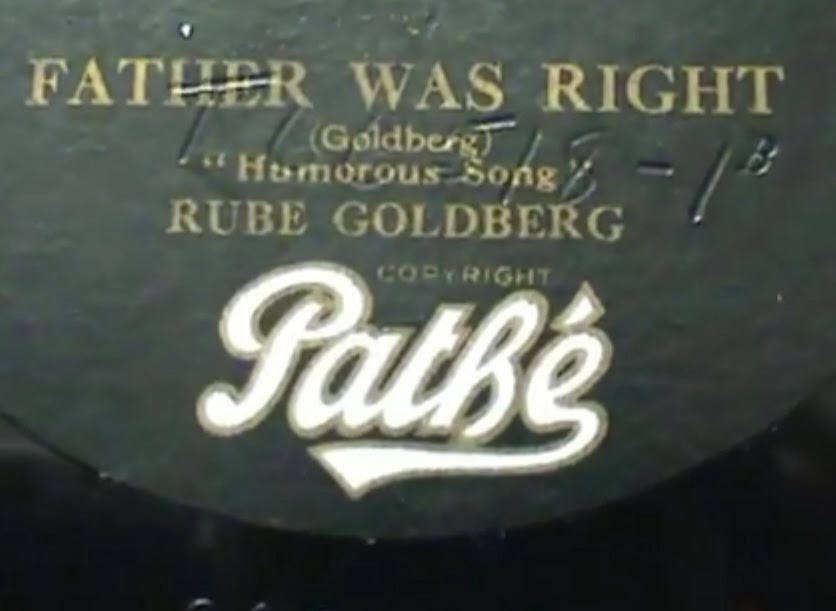
The only known instance of Rube himself creating a commercial recording of one of his songs is the 1917 Pathé record, "Father Was Right." The actual sheet music was published in 1916, and featured original Rube Goldberg cartoons:
![]() |
| Front cover of sheet music by Rube Goldberg (courtesy Robert Beerbohm) |
![]() |
| Back cover of sheet music by Rube Goldberg (courtesy Robert Beerbohm) |
The song was based on Rube's cartoon series, "Father Was Right," which he rotated through his daily cartoon space in newspapers with several other series and one-shot comic strips. Rube had a special relationship with his father, Max. His mother died when Rube was very young, and his father, a banker and later the sheriff of San Francisco, raised Rube and his siblings on his own. Rube stayed close to his Dad all his life, visiting often and calling upon him to negotiate his business deals and syndicate contracts.
![]() |
| FATHER WAS RIGHT and I NEVER THOUGHT OF THAT by Rube Goldberg (April 3, 1918, from the collection of Paul Tumey) |
The strip followed the same basic formula each time. In panel one, a father provides his son with sound practical advice. The son ignores it, gets into comical trouble, and in the last panel he comes to realize that "father was right!"
The irony of the strip is that Rube's father wanted his cartoon-crazy son to become a mining engineer, and put him through the University of California for that purpose. Max felt that an engineer was a secure and good living. Upon Rube's graduation, Max pulled some strings and git him a job working the City of San Francisco, designing their sewer system (imagine that!). After six months, Rube could no longer contain himself and squirted out of his well-paying job into a career as a newspaper cartoonist at a substantially reduced salary -- in effect ignoring his father's career advice. Of course, you know the rest of the story -- Rube became a huge success. In fact, when he recorded "Father Was Right" in 1918, he had a millionaire's salary, in today's money.
The "Father Was Right" comic strip saw heavy rotation in 1917 and 1918. Rube also created a companion strip, "Mother Was Right." This one ran much less often. "Mother Was Right" was always drawn in silhouettes -- the only strip in which Rube Goldberg used this visual approach. Perhaps it was Rube's way of acknowledging his mother, Hannah, who had tragically passed away at age forty-four when he only nine years old.
The 1917 Pathé recording of Rube singing is priceless. We are indebted to "MusicBoxBoy," the collector who made this available at YouTube. Unfortunately, Rube was recorded poorly, and the production standards for making the Pathé discs were considerably less than perfect. However, with some concentration, it's not too hard to make out the words Rube is singing-talking.
It's worth the effort to listen closely through the hiss and pops, because Rube delivers a richly comic performance. He's not a trained singer, and the song lacks aesthetic beauty -- but as comedy, it's golden. Rube adds a layer of humor beyond the funniness of the lyrics by starting out with a great, big, rude, mock throat clearing. Between verses, he repeats the throat clearing, at one point muttering an aside: "I'm suffering as much as you." Then, the act of saying this has thrown his timing off and he stops in mid-word, and says dryly, "wrong again" and waits until the music comes around the right place before he starts in on the last verse.
We can also spot Rube recycling some of his material as he uses a verse from this song in his October 11, 1926 daily strip, shown below. Luke, of "Luke and His Uke" usurps a piano performance of a Beethoven composition, as he sings: "His wife's relations came to eat/In droves of tens and eights/And so he said, "I guess I married/The whole United States." A person in the audience exclaims, 'Wot a talent!" Rube may have been poking fun at himself with this in-joke, since his one commercial performance as a singer, while quite funny, probably never made Caruso break out in a sweat.
![]() |
| Cartoon Follies of 1926 by Rube Goldberg (October 11, 1926) |
All in all, this is a wonderful find, and I'm pleased to bring it to you. Herewith, without "father" ado, is Rube Goldberg's 1917 recording of his song, "Father Was Right," with the lyrics transcribed below.
Written and Sung by Rube Goldberg (Pathé Records, 1917)
[Clears throat]
When I told my Dad
That I made up my mind to wed
"Pick out a girl," he said
"Whose relatives are dead."
Little did I know the wisdom of my dear old Dad
I didn't wed an orphan,
But I wish to the Lord I had!
Father was right
Father was right
My wife has cousins by the dozen
(line garbled)
They all get here at supper time
And bring their appetites
They wear out all our spoons and plates
They come in droves of tens and eights
I married the whole United States --
Father was right!
(Throat clearing - aside: "It's getting worse")
One day I told my Dad I'd like to own a motorcar
He puffed on his cigar
And said, "You won't go far"
I bought a car to show him that I knew a thing or two
I said goodbye and turned the crank
And that's the last I knew...
Father was right
Father was right
Now my flivver* has my liver
Twisted out of sight
And when I hear an auto horn
I want to start a fight
My back is stiffer than a board
The springs have cut me like a sword
Does anyone want to buy a Ford?
Father was right!
(Throat clearing. Aside: "I'm suffering as much as you")
One day I -- (realizes he is out of synch with music - Aside: "Wrong again")
Father said move to the country where the zephyr blows
For quiet and repose
Where they have no picture shows
Now I know that father wasn't talking through his hat
There's a moving picture theater right beneath our little flat!
Father was right
Father was right
Now my family's at the movies morning noon and night
My wife's so used to darkness, I'm afraid to make a light
Her only friends are on the screen
Instead of good old Pork and Beans
She seized me movie magazine (?)
(clears throat) Ahem! Father was right
*Early 20th century slang for a car that delivers a rough ride
(Throat clearing) In -- ahem -- other news, the new book THE ART OF RUBE GOLDBERG (which has my editing and writing in it) has been getting gangbusters press and flying off the shelves. It's appeared on numerous top 10 lists. This little-known little rag called The New York Times did a wonderful piece on the book, which includes a very clever and fun video they made especially for the online article. It's great to see Rube in the public eye again!
That is All,
Screwball Paul
Tuesday, December 10, 2013
Ving Fuller's Screwball Radio Ads (1944-46)
Ving Fuller is what you get when you turn a hustling American entrepreneur into a screwball cartoonist.
I never cease to be amazed at the number and variety of schemes the man created to sell his cartoons. While he successfully placed cartoons in the nation's leading magazines and newspapers, Fuller didn't settle for this, and hustled his way into many other markets, including animated films for Glen Bray, movies, and advertising. He even made (and patented) a toy and sold it through his comic strips.
It could be that mentioning his name in his comics turned into an in-joke. I haven't seen enough of Fuller's daily and Sunday comics to know for sure. However, I have run across a sequence in Al Capp's Li'l Abner from 1959 that features Ving Fuller's name. Abner is excited that to become "a highly paid cartoonist like "Ving Fuller or Walt Kelly!"
I never cease to be amazed at the number and variety of schemes the man created to sell his cartoons. While he successfully placed cartoons in the nation's leading magazines and newspapers, Fuller didn't settle for this, and hustled his way into many other markets, including animated films for Glen Bray, movies, and advertising. He even made (and patented) a toy and sold it through his comic strips.
Fuller never broke big with a comic strip property. He came close in 1934 when he created the first Betty Boop related comic, but appears to have been stymied by a legal snafu. He tried again a few years later in 1939 when he drew Elza Poppin, a comic strip loosely named after a smash Broadway and film screwball hit, Hellzapoppin. Ving lost the job after six months (according to one story, he attempted to sue the owners of the play for royalties on the strip, and was thrown out of court and a job) and he was replaced after six months by fellow screwballist George "Swan" Swanson (Salesman Sam).
Ving finally had success with his 15-year old comic strip, Doc Syke (1945-1960) but it remained on the fringes of newspaper comics, hopping from syndicate to syndicate. Ving constantly tinkered with the strip to make it sell better, even going so far as to re-tool the strip in the early 1950s to become a doppelganger of the then new Peanuts comic strip by Charles Shulz.
![]() |
| Cartoonist Ving Fuller and brother Sam Fuller (yes, the famous filmmaker) at a cartoonist's dinner, c. 1940s |
As a persistent media archaeologist, my never-ending search for Ving Fuller material is rewarded more often than I'd expect. His eccentric cartoon art turns up in the oddest places. Such as in a 1940s radio trade magazine. I recently discovered a series of about two dozen delightfully screwy comic strips by Ving Fuller promoting advertising time to media buyers ("timebuyers") for the New York radio station WOV.
A lot of the ads in this magazine used cartoon art, but none of it was one-tenth as screwball (or interesting) and Fuller's work. The earliest example I found is from August, 1944:
![]() |
| BROADCASTING featured several full-page trade ads with Ving Fuller's comics in the mid-1940s |
![]() |
| Ving Fuller comic from BROADCASTING (August 23, 1944) |
The image at the top reminds me a little of Basil Wolverton, in that Fuller is making comedy out of an ugly character. The juxtaposition of a photo with the line art is also attention-getting, in a goofy way. Fuller's WOV ads were aimed at people who worked for advertising agencies. Many of these agencies provided clever creative print and radio ads to their clients, and so it was necessary to use the same sort of offbeat, hip advertising to gain their attention and win their confidence. In this work, Fuller sits firmly (if obscurely) in the tradition of Rube Goldberg, Dr. Seuss and Virgil Partch, iconoclastic cartoon stylists who provided their services to the world of print advertising.
Unlike Goldberg, Seuss, or Partch, Fuller was not necessarily a "name" cartoonist. He wasn't associated with a popular newspaper character (although he does work in his character Doc Syke into one of the ads). This meant that he had work even harder to make the ads funny and entertaining -- while at the same time promoting "timebuying" opportunities. This was no easy feat, and sometimes his ads were a little soft, although the cartooning was -- as always -- authentic and pleasingly nutty:
![]() |
| Ving Fuller comic from BROADCASTING (October 23, 1944) |
Apparently, someone at WOV liked Fuller's work. They hired him for about two years and made him the star of their trade campaign, as this squib from the December 10th, 1945 issue of Broadcasting shows:
![]() |
| BROADCASTING (December 10, 1945) |
Ving Fuller was as iconoclastic in his own profession as his more famous brother, Sam, was in his profession as a film director. What is really interesting to me about Fuller is that his sense of humor is as offbeat as his schemes for selling his cartoon art. Here's a wonderfully weird example:
![]() |
| Ving Fuller comic from BROADCASTING (October 22, 1945) |
Here's another delightfully wacky example. Note the golf course gopher humor -- decades before Caddyshack.
![]() |
| Ving Fuller comic from BROADCASTING (November 25, 1946) |
And here's a smokin' idea for a four-pipe, er, four-PANEL strip. Check out the array of crazy pipes in the background, and the "P.S." gag in panel one.
The last example in the series that I can find is, in some ways, the wackiest of them all, with the artist putting himself into the trade ad. Perhaps Fuller knew his contract wouldn't be renewed, and so he decided to wring a little self-promotion out of the piece.
![]() |
| Ving Fuller comic from BRAODCASTING (October 28, 1946) |
The last example in the series that I can find is, in some ways, the wackiest of them all, with the artist putting himself into the trade ad. Perhaps Fuller knew his contract wouldn't be renewed, and so he decided to wring a little self-promotion out of the piece.
![]() |
| Ving Fuller comic from BROADCASTING (December 23, 1946) |
It could be that mentioning his name in his comics turned into an in-joke. I haven't seen enough of Fuller's daily and Sunday comics to know for sure. However, I have run across a sequence in Al Capp's Li'l Abner from 1959 that features Ving Fuller's name. Abner is excited that to become "a highly paid cartoonist like "Ving Fuller or Walt Kelly!"
![]() | |
|
![]() |
| Al Capp's LI'L ABNER plugs Ving Fuller (December 14, 1958) |
This is your friendly neighborhood media archeaologist, Paul "A Real Screwball" Tumey, signing off!
Subscribe to:
Posts (Atom)